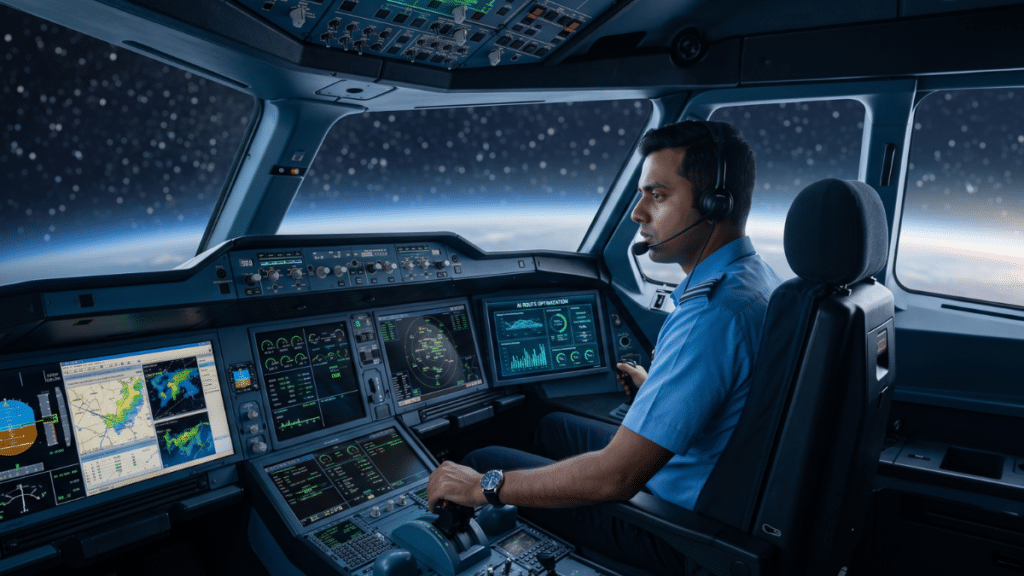
Picture yourself settling into the captain’s seat of a Boeing 787 Dreamliner. The flight deck glows with digital displays, weather radar paints a picture of clear skies ahead, and sophisticated systems are already calculating the most fuel-efficient route to your destination. Your co-pilot? Well, part of your team includes an AI system monitoring dozens of parameters simultaneously, predicting potential issues before they become problems, and helping you make better decisions at 35,000 feet. This is not some distant fantasy. This is aviation right now, and if you are training to become a pilot, this is the world you are stepping into.
The conversation around AI in aviation often triggers a mix of excitement and anxiety among aspiring pilots. Will technology make pilots obsolete? Does automation mean the romance of flying is dead? Here is the truth that instructors at flight schools rarely emphasize enough: automation is not replacing pilots. It is creating a new generation of aviators who are smarter, safer, and more capable than ever before. Whether you are just beginning ground school or already logging hours toward your private pilot license, understanding how AI and automation fit into your future career is not just helpful. It is essential.
Understanding AI in Aviation: More Than Just Autopilot
When most people think about AI in aviation, their minds jump straight to autopilot. But modern aviation technology has evolved far beyond the basic autopilot systems your parents might remember. Today’s AI-powered aviation systems use machine learning algorithms, predictive analytics, and real-time data processing to make thousands of micro-decisions during every phase of flight.
The Airbus A350 and Boeing 787, for instance, incorporate AI-driven systems that monitor engine performance, optimize fuel consumption, and even predict when components might need maintenance before they fail. These are not simple “if-then” programs. They learn from vast amounts of operational data, recognize patterns, and adapt to changing conditions. Think of it as having an incredibly knowledgeable flight engineer working silently in the background, except this one never gets tired and processes information faster than any human could.
What makes this especially relevant for student pilots is that these systems are becoming standard equipment, not exotic upgrades. The aircraft you train in today at Pilots Academy might have glass cockpit displays and digital flight management systems that would have seemed like science fiction just 20 years ago. Getting comfortable with this technology during your training gives you a massive advantage when you transition to commercial operations.
Current Automation in the Cockpit: What’s Already Here
Walk into any modern flight deck and you will see layers of automation working together. The Flight Management System handles navigation and performance calculations. The auto-throttle manages engine power settings with precision no human hand could match. Traffic Collision Avoidance Systems provide an extra set of eyes scanning for nearby aircraft. Synthetic vision systems generate a clear picture of terrain even when visibility drops to zero.
These systems are not just conveniences. They represent decades of safety improvements. According to Boeing’s annual safety report, accident rates have decreased by over 95% since the 1960s, largely due to technological advances and better automation. But here is what matters for your training: you need to understand not just how to use these systems, but when to trust them and when to take manual control.
During your instrument rating training, you will spend considerable time learning how these automated systems interact. You will discover that good pilots do not simply program the autopilot and sit back. They actively monitor, verify, and stay mentally engaged with what the aircraft is doing. This is the skill that separates average pilots from exceptional ones.
Emerging AI Technologies Transforming Flight Operations
The next wave of AI in aviation goes even further. Predictive maintenance systems now analyze vibration patterns, temperature fluctuations, and performance data to forecast mechanical issues days or weeks before they would ground an aircraft. Airlines using these AI-driven maintenance programs report 30-40% reductions in unscheduled maintenance events.
Weather avoidance is getting smarter too. AI algorithms process satellite data, pilot reports, and meteorological models to suggest route adjustments that avoid turbulence more effectively than traditional methods. Some experimental systems use computer vision to detect runways and obstacles, providing backup awareness that could prevent runway incursions.
Perhaps most intriguing are the AI systems being tested for air traffic control communications. While still in development, natural language processing could eventually help pilots communicate more efficiently with ATC, reducing misunderstandings that sometimes lead to safety incidents. These technologies might sound futuristic, but they are closer to reality than most people realize.
The Pilot’s Evolving Role: From Stick and Rudder to Systems Manager
There is a common saying in modern aviation: pilots have evolved from stick-and-rudder operators to systems managers. This does not mean manual flying skills have become irrelevant. Far from it. What it means is that your responsibilities have expanded. You still need solid hand-flying abilities for those moments when automation fails or when conditions demand human judgment. But you also need to understand complex systems, interpret data quickly, and make informed decisions about when to use automation and when to fly manually.
This concept of “pilot monitoring” versus “pilot flying” has become central to crew resource management in highly automated aircraft. Even when the autopilot is handling the controls, the monitoring pilot stays actively engaged, cross-checking systems, anticipating what should happen next, and preparing for potential contingencies. This cognitive involvement is crucial because automation can sometimes mask developing problems until they become critical.
Flight schools worth their salt now emphasize this balance from day one. At Pilots Academy, we ensure students build strong foundational flying skills while simultaneously developing proficiency with modern avionics and automated systems. You need both skill sets to thrive in contemporary aviation.
What This Means for Your Pilot Training Journey
So how does all this affect your path to the cockpit? First, expect your training to include substantial exposure to glass cockpit technology and flight management systems. Even during primary training for your private pilot license, you will likely work with digital displays, GPS navigation, and autopilot systems. This early exposure is intentional. It prepares you for the reality of modern flying.
Second, your ground school curriculum will include more emphasis on understanding how automated systems work, not just how to operate them. You will learn about system logic, failure modes, and the human factors challenges that come with automation. Topics like automation dependency, mode confusion, and maintaining situational awareness in highly automated environments are now standard parts of pilot education.
Third, simulator training has become more sophisticated and more valuable. Modern flight simulators can replicate not just aircraft handling characteristics but also the full suite of automated systems you will use in real aircraft. This means you can practice managing complex scenarios, system failures, and decision-making under pressure without ever leaving the ground. It is an incredibly efficient way to build competence and confidence.
The beautiful thing about training in this era is that you get the best of both worlds. You still learn to fly by feel, to read the sky, to handle an aircraft smoothly through all phases of flight. But you also gain proficiency with tools that make you safer, more efficient, and more capable than any previous generation of pilots.
Will AI Replace Pilots? Addressing the Big Question
Let us tackle the elephant in the cockpit: will AI in aviation eventually eliminate the need for human pilots? The short answer is no, not in any timeframe that should concern someone starting flight training today. The longer answer is more nuanced and actually quite reassuring.
Aviation regulators, aircraft manufacturers, and airlines have all studied pilotless or single-pilot operations extensively. The consensus is clear: removing humans from the cockpit creates more problems than it solves. The Air France 447 accident in 2009 is often cited as evidence that automation alone is not enough. When the aircraft’s airspeed sensors failed, the automated systems handed control back to the pilots, but the situation had already become confusing. Human judgment was needed, but the suddenness of the transition made it harder for the crew to respond effectively.
This paradox, sometimes called the “ironies of automation,” shows that as systems become more capable, the human role becomes more critical, not less. You will be needed for the unexpected situations, the judgment calls, the creative problem-solving that no algorithm can match. The demand is to recognize when automation is doing something unexpected and to take appropriate action. You are needed because passengers, quite simply, want to know there is a trained, experienced human being at the controls.
The pilot shortage facing the industry tells another part of this story. Airlines worldwide are struggling to find enough qualified pilots to meet demand. Boeing projects the industry will need more than 600,000 new pilots over the next 20 years. That does not sound like a profession being automated away.
Preparing for Tomorrow’s Cockpit: Skills You’ll Need
Succeeding in the era of AI in aviation requires a specific blend of skills. Technical proficiency with digital systems and modern avionics is non-negotiable. You need to be comfortable with computers, comfortable learning new software, and comfortable troubleshooting when things do not work as expected. If technology intimidates you, aviation will push you to get over that quickly.
But do not neglect the fundamentals. Strong hand-flying skills remain essential. Practice slow flight, steep turns, crosswind landings, and unusual attitude recoveries until they become second nature. These core competencies are your foundation. Everything else builds on them.
Develop your systems thinking abilities. Modern aircraft are complex machines with interconnected systems. Understanding how changing one parameter affects others, how failures cascade, and how to prioritize in emergencies requires a particular kind of analytical thinking. Ground school and simulator training will help develop this, but staying curious and asking “why” questions accelerates your learning.
Perhaps most importantly, cultivate adaptability. Aviation technology will continue evolving throughout your career. The aircraft you fly in 20 years will have capabilities we cannot fully imagine today. Pilots who thrive are those who embrace continuous learning, who stay current with new procedures and technologies, and who approach change with curiosity rather than resistance.
The Future Is Collaborative: Humans and AI Working Together
The most accurate way to think about aviation’s future is not humans versus AI, but humans and AI working as a team. AI handles the routine, repetitive, data-intensive tasks that it excels at: monitoring dozens of parameters simultaneously, calculating optimal performance settings, processing weather data, tracking aircraft systems for signs of degradation. This frees human pilots to focus on what we do best: strategic decision-making, creative problem-solving, adapting to unexpected situations, and providing the judgment and oversight that ensures safe operations.
This collaboration has already delivered impressive results. Modern aircraft are more fuel-efficient than ever, with AI-optimized flight paths reducing fuel consumption by 5-10% on many routes. That translates to fewer emissions and lower operating costs. Safety continues to improve year after year. The worldwide commercial jet accident rate in 2023 was the lowest in aviation history.
Looking ahead, we can expect AI systems to become even more integrated into flight operations. Enhanced vision systems might provide better situational awareness in low visibility. Predictive analytics could help pilots make better decisions about weather routing, fuel planning, and operational risks. Some aircraft might eventually feature AI co-pilots that assist with routine tasks, allowing single-pilot operations for cargo flights or smaller aircraft.
But commercial passenger operations? Those will have human pilots for the foreseeable future, and those pilots will be better equipped, better supported, and more capable than ever before thanks to AI assistance. If you are passionate about flying, now is genuinely one of the best times in history to pursue this career.
Your Future in Aviation Starts Here
The future of flying is not about choosing between human skill and artificial intelligence. It is about combining the best of both. As AI in aviation continues advancing, pilots who understand technology, maintain strong foundational skills, and approach their careers with adaptability will find incredible opportunities awaiting them.
At Pilots Academy, we prepare students for this evolving landscape. Our training programs balance time-tested flying fundamentals with hands-on experience in modern glass cockpit aircraft. We teach you to be confident with automation while ensuring you can fly precisely and safely when technology steps aside. Our instructors bring real-world experience from commercial aviation, and they understand what skills you need to succeed in today’s industry.
Whether you are just discovering your passion for aviation or you are already working through ground school, remember this: the technology in the cockpit is a tool that amplifies your capabilities. The judgment, dedication, and love of flying that brought you to aviation in the first place? That is still what matters most. The aircraft may be smarter than ever, but they still need skilled, thoughtful humans to fly them.
Ready to begin your journey into modern aviation? Schedule a discovery flight with Pilots Academy and experience firsthand how we blend traditional flying skills with cutting-edge technology. Talk with our instructors, explore our fleet, and discover why now is such an exciting time to pursue your dream of flight. Your future in the cockpit starts with a single decision to begin. We are here to guide you every step of the way.
Frequently Asked Questions
Will automation make pilot jobs disappear?
No, automation will not eliminate pilot jobs. While technology handles more routine tasks, pilots remain essential for decision-making, handling emergencies, and providing judgment in complex situations. The global pilot shortage and industry projections for hiring hundreds of thousands of pilots over the next two decades confirm that demand for qualified pilots remains strong.
Do I need to be good at computers to be a pilot?
You do not need to be a software engineer, but basic comfort with technology is important. Modern flight training includes digital systems, flight management computers, and electronic flight displays. If you can use a smartphone and learn new apps, you have the baseline tech skills needed. Flight schools teach you the aviation-specific systems from scratch.
Will I still learn to fly manually or just use autopilot?
You absolutely learn to fly manually first. Private pilot training emphasizes hand-flying skills, and you will spend most of your early training flying the aircraft yourself. Autopilot and advanced systems come later, after you have mastered basic aircraft control. Even airline pilots regularly practice manual flying to maintain proficiency.
How much does modern flight training cost with all this technology?
Training costs vary by location and program, but glass cockpit aircraft often cost only slightly more to rent than traditional steam gauge aircraft. The investment is worthwhile because you graduate with experience in the systems you will actually use in your career. Many flight schools, including Pilots Academy, offer structured programs that provide cost transparency and financing options. Explore our training programs and pricing to find an option that fits your goals and budget.
What happens if all the technology fails in the cockpit?
Aircraft are designed with multiple layers of redundancy. Critical systems have backups, and pilots train extensively for technology failures. Your training includes flying with partial panel, handling system malfunctions, and reverting to basic instruments when needed. This is why strong fundamental flying skills remain so important even in highly automated aircraft.