Ever watched a Boeing 747 lumber down the runway and thought, “How does 400 tons of metal and fuel just float into the sky?” If you’re like most aspiring pilots, that question has crossed your mind more than once. The good news is that understanding how airplanes fly is not some mysterious secret reserved for aerospace engineers. It’s actually a beautiful combination of physics principles that, once you grasp them, will transform the way you see every flight.
Whether you’re just starting ground school or already logging hours toward your private pilot license, knowing the science behind flight makes you more than just someone who can operate an aircraft. It makes you a pilot who truly understands the machine, anticipates its behavior, and makes smarter decisions in the cockpit. At Pilots Academy, we believe that solid theoretical knowledge creates confident, capable aviators. So let’s break down exactly what keeps an airplane in the air, and why these principles matter for your flying career.
The Four Forces of Flight: Your Foundation for Understanding How Airplanes Fly
Before we dive into the complex physics, you need to know the fundamental framework that governs all flight: the four forces. Every time an aircraft moves through the sky, four distinct forces act upon it: lift, weight (or gravity), thrust, and drag.
Think of these forces as a constant push and pull. Lift works upward against weight pulling downward. Thrust propels the aircraft forward while drag resists that motion. When these forces are balanced during steady, level flight, the airplane maintains its altitude and speed. When they’re out of balance (like during takeoff or a climb), the aircraft accelerates, climbs, or descends.
Understanding this relationship is not just academic. As a pilot, every control input you make affects these forces. Pull back on the yoke, and you’re increasing the angle of attack to generate more lift. Add power, and you’re increasing thrust to overcome drag. The four forces are not abstract concepts; they’re the reason your aircraft responds the way it does.
Lift: The Force That Defies Gravity
Lift is the superstar of the four forces because it’s what actually gets the aircraft off the ground. But how exactly does a wing generate enough upward force to counteract gravity and lift thousands of pounds into the air?
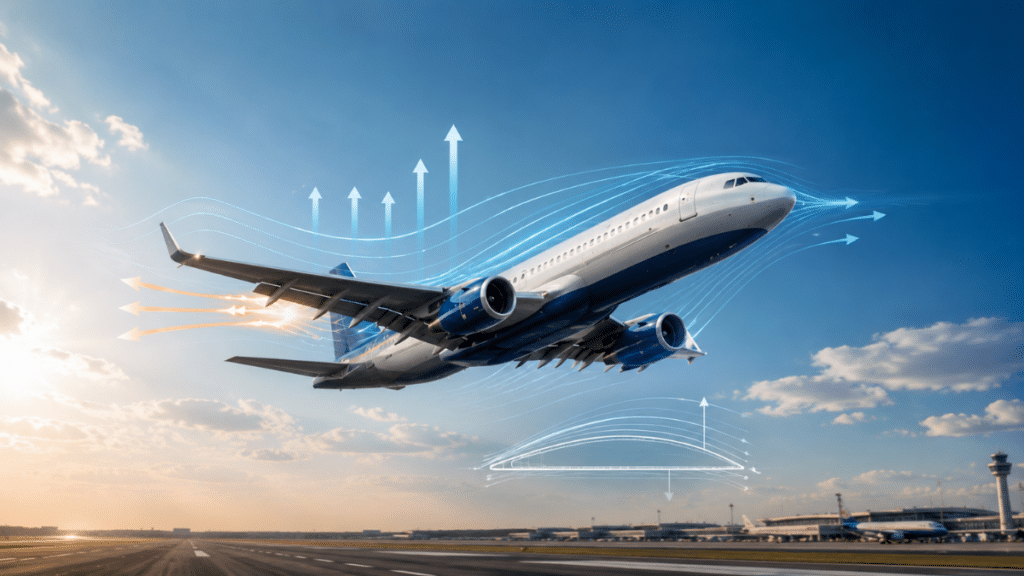
The answer lies in the shape of the wing, specifically its airfoil (the cross-sectional shape you’d see if you sliced through the wing). The curved upper surface and flatter lower surface create different airspeeds as air flows over and under the wing. This leads to a pressure differential: lower pressure above the wing and higher pressure below. That pressure difference pushes the wing upward, creating lift.
But lift is not just about wing shape. Several factors affect how much lift a wing generates: airspeed (faster = more lift), wing area (bigger = more lift), air density (thicker air = more lift), and angle of attack (the angle at which the wing meets the oncoming air). This is why your instructor constantly emphasizes maintaining proper airspeed, especially during takeoff and landing. Too slow, and you do not generate enough lift to stay airborne.
Bernoulli’s Principle and Airflow: The Pressure Game
You have probably heard of Bernoulli’s principle in ground school, and for good reason. This 18th-century discovery explains a critical part of how airplanes fly: when air speeds up, its pressure drops.
As air flows over the curved top of the wing, it accelerates. According to Bernoulli’s principle, that faster-moving air has lower pressure compared to the slower-moving air underneath the wing. This pressure differential is a major contributor to lift. The wing is literally being pushed upward by the higher pressure below.
Now, here is where some textbooks get it wrong. You might have heard the “equal transit time” theory, which claims that air particles separated at the leading edge of the wing must meet again at the trailing edge, so the air on top has to move faster. That sounds logical, but it is actually incorrect. Air particles do not reunite, and the real reason for faster airflow on top is the wing’s shape forcing air to travel a longer path and accelerate.
What matters for you as a student pilot is this: airspeed equals lift. Lose too much speed, especially at a high angle of attack, and you risk a stall. Bernoulli’s principle is not just theory; it is a constant reminder that your airspeed indicator is one of your most important instruments.
Newton’s Laws: Action, Reaction, and Downwash
While Bernoulli’s principle explains part of the lift equation, Sir Isaac Newton’s third law of motion completes the picture: for every action, there is an equal and opposite reaction.
When a wing moves through the air, it does not just create a pressure difference. It also deflects air downward, a phenomenon called downwash. By pushing a massive amount of air down, the wing experiences an equal and opposite force pushing it up. This is Newton’s third law in action, and it accounts for a significant portion of total lift.
The angle of attack plays a huge role here. When you increase the angle of attack (pitching the nose up), the wing deflects more air downward, generating more lift. But there is a limit. Increase the angle too much, and the smooth airflow over the wing breaks down, causing a stall. Understanding this balance between angle of attack and lift is essential for safe flying, especially during slow flight or landing approaches.
Both Bernoulli and Newton work together to explain how airplanes fly. Pressure differential plus momentum change equals the total lift that keeps you in the air.
Drag: The Unavoidable Opponent
If lift is the hero of flight, drag is the persistent villain. Drag is the aerodynamic resistance that opposes your forward motion through the air, and it comes in two main forms: parasite drag and induced drag.
Parasite drag increases with speed and includes all the drag from the aircraft’s shape, surface friction, and turbulence. Think of it as everything that is not directly related to producing lift: the fuselage cutting through the air, landing gear hanging down, even bugs splattered on the windshield. Anything that disrupts smooth airflow adds parasite drag.
Induced drag, on the other hand, is a byproduct of generating lift. When the wing creates lift, it also creates wingtip vortices (spiraling air currents at the wingtips) that increase drag. Interestingly, induced drag is highest at low speeds and high angles of attack, which is why you feel more drag during takeoff and landing.
As a pilot, you manage drag constantly. Retract the landing gear after takeoff to reduce parasite drag. Use flaps during landing to increase lift without needing excessive speed, even though they also add drag. Understanding drag helps you make smarter decisions about aircraft configuration, fuel efficiency, and performance.
Thrust and Weight: Completing the Four-Force Picture
Thrust is the force that moves your aircraft forward, generated by the engine turning a propeller or expelling high-speed exhaust gases (in jets). It must overcome drag to maintain or increase airspeed, and it works in tandem with lift to get the aircraft into the air.
Different aircraft use different propulsion systems. Training aircraft typically use piston engines with propellers, which are efficient at lower speeds and altitudes. Larger commercial aircraft use turbofan engines, which excel at high speeds and high altitudes. Regardless of the engine type, the principle is the same: thrust pushes you forward so the wings can generate lift.
Weight, the fourth force, is simply gravity pulling the aircraft toward the Earth. Weight affects every aspect of flight performance: a heavier aircraft needs more lift (and therefore more speed) to take off, climbs more slowly, and burns more fuel. This is why weight and balance calculations are not just bureaucratic paperwork; they are critical safety checks that ensure the aircraft can perform as expected.
Managing weight is something you will do before every flight. Understanding how weight affects the four forces helps you plan better, fly safer, and make informed decisions about fuel loads, passenger distribution, and cargo.
Wing Design: Engineering Lift into Every Flight
Wings are not just flat boards bolted to the fuselage. They are carefully engineered structures designed to maximize lift, minimize drag, and handle the stresses of flight. The airfoil shape, wing planform, and additional devices all contribute to how well an aircraft flies.
Training aircraft often have high-wing designs with thick airfoils that generate lots of lift at lower speeds, making them stable and forgiving for students. Fighter jets have thin, swept wings designed for high-speed flight. Airliners use winglets (those upturned tips at the wingtips) to reduce induced drag and improve fuel efficiency.
High-lift devices like flaps and slats are game-changers during takeoff and landing. Flaps extend from the trailing edge of the wing to increase both lift and drag, allowing you to fly slower without stalling. Slats extend from the leading edge to improve airflow at high angles of attack. These devices give pilots more control during critical phases of flight, and understanding how they work makes you a more competent aviator.
From Theory to the Cockpit: Applying Aerodynamics in Real Flight
Everything we have covered is not just for passing your written exam. These principles come alive the moment you take the controls.
During takeoff, you are managing all four forces: increasing thrust to accelerate, rotating at the right speed to increase angle of attack and generate lift, and watching your airspeed to ensure you have enough margin above stall speed. In cruise flight, you are balancing thrust and drag while maintaining just enough lift to equal weight. During landing, you are using drag (from flaps, gear, and reduced power) to control your descent while keeping enough airspeed to maintain lift until touchdown.
The “aha” moment for most student pilots comes when they realize they are not just memorizing facts; they are learning to predict and control how the aircraft behaves. When you understand why the nose pitches up when you add power, or why the aircraft wants to descend when you reduce throttle, you are thinking like a real pilot.
That confidence, that deep understanding of how airplanes fly, is what separates pilots who simply operate aircraft from pilots who master them.
Your Journey Starts with Understanding
The science of how airplanes fly is not just fascinating; it is foundational. Every control input, every maneuver, every decision you make in the cockpit connects back to these aerodynamic principles. Understanding lift, drag, thrust, and weight transforms you from someone who just moves the controls to a pilot who truly commands the aircraft.
At Pilots Academy, we are passionate about building pilots who do not just fly, but who understand flight at a deep level. Our instructors bring these principles to life, connecting ground school theory with real-world flying experience. Whether you are preparing for your first discovery flight or working toward your commercial license, we are here to guide you every step of the way.
Ready to turn this knowledge into real flying skills? Explore our flight training programs and discover how we can help you achieve your aviation dreams. The sky is not the limit when you understand the science that makes flight possible.
FAQs About How Airplanes Fly
Can a plane fly upside down?
Yes, aerobatic aircraft can fly inverted by angling the wing (now on the bottom) to deflect air downward, creating lift through angle of attack rather than wing shape. However, standard aircraft are not designed for sustained inverted flight and would require extreme control inputs.
What happens if an airplane loses engine power?
The aircraft becomes a glider. Lift still works as long as the aircraft maintains forward speed, so pilots can glide to a safe landing. This is why we practice engine-out procedures extensively during training.
Why do planes need to go so fast to take off?
Lift is directly related to airspeed. The aircraft needs to reach a specific speed (called rotation speed or Vr) where the wings generate enough lift to overcome the aircraft’s weight. Heavier aircraft need more speed to generate sufficient lift.
How does altitude affect how airplanes fly?
Higher altitudes have thinner air (lower density), which reduces lift and engine performance. This is why aircraft need longer takeoff distances at high-altitude airports and why there are altitude limits for different aircraft types.
What causes turbulence, and is it dangerous?
Turbulence is caused by irregular air currents from weather, terrain, or jet streams. While uncomfortable, it rarely poses a danger to modern aircraft, which are built to handle significant stress. Pilots avoid severe turbulence when possible, but light to moderate turbulence is a normal part of flying.
Do heavier planes need bigger wings?
Generally, yes. Larger, heavier aircraft need more wing area to generate sufficient lift. However, wing design is complex and also considers speed, mission, and efficiency. Some fast aircraft have smaller wings because they generate lift through high speed.
Why do planes have different wing shapes?
Wing design depends on the aircraft’s purpose. Straight wings are efficient at low speeds (trainers, bush planes). Swept wings reduce drag at high speeds (airliners, jets). Delta wings offer strength and performance for supersonic flight (military aircraft). Each design optimizes for specific flight characteristics.