
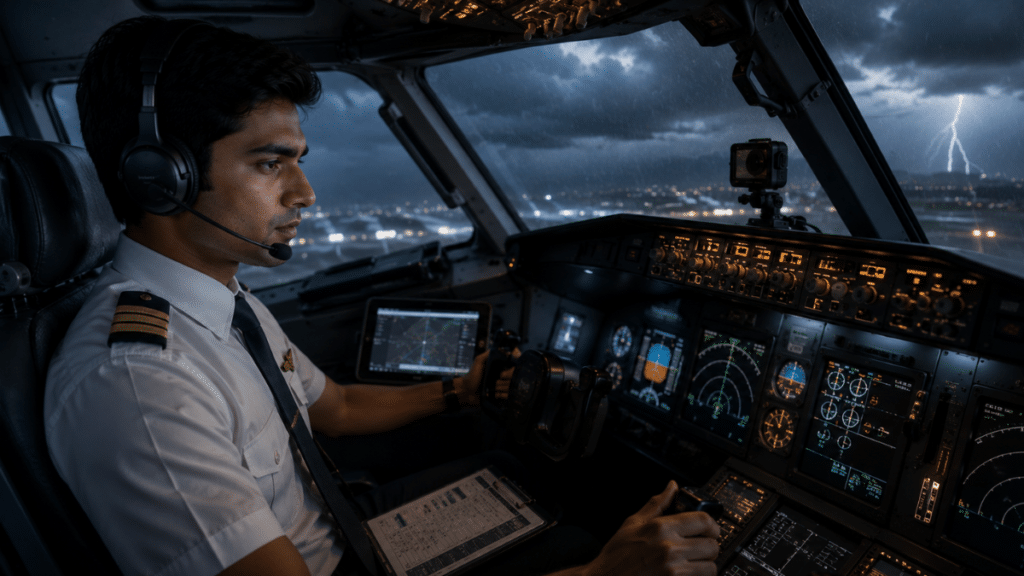
Your heart starts pounding. Tower just changed your runway assignment while you’re on short final. The winds are gusting at 18 knots. Your instructor sits quietly beside you, watching. Every student pilot has been there, that moment when everything feels like it’s happening too fast. Here’s what nobody tells you during ground school: learning to fly isn’t just about mastering steep turns and navigation. It’s about developing the mental skills to stay calm when things don’t go as planned.
Cockpit stress management is one of those critical skills that separates good pilots from great ones. Whether you’re preparing for your first solo or working toward your commercial license, understanding how to handle pressure in the flight deck will shape your entire aviation career. The encouraging news? Just like perfecting your landings or instrument approaches, managing stress is completely learnable. We’ve trained hundreds of pilots through challenging moments, and we’re sharing the exact techniques that work.
Why Cockpit Stress Management Matters for Every Pilot
Let’s talk about something the aviation industry takes seriously: the connection between stress and safety. NASA’s Aviation Safety Reporting System shows that a significant number of incidents involve some element of pilot stress or task saturation. When we’re overwhelmed, our brain’s ability to process information drops. We miss radio calls or fixate on one problem while ignoring others. We make decisions we’d never make on the ground.
Student pilots often think experienced captains don’t feel pressure. That’s not true. The difference is how they’ve learned to manage it. Professional aviators use specific cockpit stress management techniques that keep them performing well even during emergencies. These aren’t mystical talents. They’re practical skills you can start developing during your very next flight lesson.
Here’s the reality: some stress actually helps performance. That heightened awareness during your checkride? That’s eustress, the productive kind of pressure that sharpens your focus. The problem starts when stress crosses into anxiety, when it stops helping and starts interfering with your decision-making. Learning to recognize that line is essential.
Understanding Your Personal Stress Triggers in Flight
Every pilot has different pressure points. For some students, it’s talking to air traffic control. For others, it’s crosswind landings or the thought of that upcoming stage check. We’ve noticed that many aspiring pilots put enormous pressure on themselves to be perfect, especially during training. That internal voice saying “you should know this already” creates more stress than the actual flying.
Common triggers include unexpected weather changes, busy traffic patterns, mechanical irregularities, and time pressure. Maybe you’re worried about the Hobbs meter running while you’re trying to sort out a navigation problem. Perhaps you’re comparing yourself to other students who soloed before you did. These mental factors affect your performance just as much as environmental ones.
Start paying attention to your body’s early warning system. Does your breathing get shallow? Do your shoulders tense up? Does your mind go blank when you’re trying to read back a complex clearance? Recognizing these signs early gives you the chance to intervene before stress escalates. We encourage our students to keep honest training journals where they note what situations felt challenging and why. Patterns emerge quickly, and awareness is the first step toward improvement.
Pre-Flight Preparation: Your First Line of Defense
The best cockpit stress management happens before you even start the engine. Thorough flight planning eliminates uncertainty, and uncertainty is stress fuel. When you’ve thought through your route, checked weather trends, identified alternate airports, and reviewed the procedures at your destination, you build a foundation of confidence.
Chair flying might feel awkward at first, but it works. Sit somewhere quiet and mentally rehearse your entire flight. Visualize yourself handling the radios, managing the pattern, dealing with that tricky frequency change. Sports psychologists have proven that mental rehearsal activates the same neural pathways as actual practice. Your brain doesn’t fully distinguish between vivid visualization and real experience.
Try the “what if” game during your planning. What if tower assigns a different runway or need to divert? What if you hear “go around” on short final? Having thought through scenarios in advance means you’re not starting from zero when surprises happen. We teach our students that preparation isn’t about preventing all problems. It’s about reducing the number of things that can catch you completely off guard.
Physical preparation matters too. You can’t manage flight deck stress effectively when you’re running on four hours of sleep and three cups of coffee. Proper rest, hydration, and nutrition directly affect your cognitive function and stress resilience. Professional pilots treat their bodies like athletes do because flying demands mental and physical stamina.
Breathing and Physical Techniques for Immediate Relief
Here’s a technique you can use right now: the 4-7-8 breath. Inhale through your nose for four counts, hold for seven, exhale slowly through your mouth for eight. This activates your parasympathetic nervous system, the part that tells your body to calm down. During cruise flight or while your instructor demonstrates a maneuver, this simple practice can reset your stress response.
Box breathing is another favorite among pilots. Inhale for four counts, hold for four, exhale for four, hold for four. Repeat. Military aviators use this before high-pressure missions. The beauty of breathing techniques is they’re invisible and immediate. Nobody knows you’re doing them, but the physiological impact is real.
The physiological sigh, discovered by Stanford researchers, might be the fastest stress reliever available. Take a deep breath in through your nose, then take a second, shorter inhale on top of it to fully expand your lungs. Then slowly exhale through your mouth. One or two of these can significantly reduce stress levels within seconds. Use it while you’re copying clearances on the ground or during those brief moments in cruise when workload is lower.
Just remember: never close your eyes or do anything that compromises your ability to fly the aircraft. These techniques work precisely because they can be done while maintaining full awareness of your surroundings.
Managing Cockpit Workload When Everything Happens at Once
Aviate, navigate, communicate. This priority framework has saved countless pilots during high-pressure situations. When task saturation hits and everything seems urgent, this hierarchy tells you exactly what matters most. First, fly the airplane. Nothing else matters if you’re not maintaining aircraft control. Second, figure out where you’re going. Third, talk to people.
We see students get this backward all the time. They’re so worried about responding to ATC that they stop flying precise headings. Or they’re so focused on finding a checkpoint that they let their altitude drift. The beautiful thing about “aviate, navigate, communicate” is how it simplifies decisions. When you’re overwhelmed, this framework cuts through the noise.
Breaking complex situations into smaller chunks reduces cognitive load dramatically. Instead of seeing “land at a busy airport” as one massive task, break it down: get ATIS, contact tower, enter the pattern, configure the aircraft, execute the approach, complete the landing. Each step is manageable. The sum of manageable steps is a successful flight.
Don’t hesitate to use the most powerful phrase in aviation: “standby.” If ATC gives you an instruction while you’re in the middle of something critical, say “standby.” Fly the airplane first. Controllers would rather wait five seconds than have a pilot miss something important because they were distracted. We teach students that asking for clarification or additional time isn’t a weakness. It’s good airmanship.
Communication Strategies That Reduce Flight Deck Stress
Radio communication anxiety is probably the most common stress trigger for student pilots. The fear of sounding foolish or making mistakes on frequency creates enormous pressure. Here’s what helps: recognize that every pilot you hear on the radio was once exactly where you are. Every captain flying a 737 today stumbled through their first radio calls.
Practice on the ground changes everything. Listen to LiveATC.com and write down what you hear. Practice reading it back. Use apps or online simulators that let you rehearse radio work without actually being in the air. The more familiar the phraseology becomes, the less mental energy it requires during flight. When communication becomes automatic, it stops being a stressor.
Clear, confident radio calls actually prevent stress rather than just responding to it. When you communicate well, you reduce confusion, you get what you need from ATC, and you free up mental space for flying. We encourage students to write down complex clearances, repeat them back accurately, and never pretend to understand something they didn’t catch. Professional pilots ask for clarification constantly.
Crew resource management principles apply even when you’re flying solo. Talk to yourself. Verbalize what you’re seeing and doing. “Checking fuel, sufficient for flight plus reserves.” “Airspeed alive.” “Three greens, gear down and locked.” This external loop helps catch mistakes and reduces the cognitive load of keeping everything in your head.
Mental Strategies Professional Pilots Use Under Pressure
Compartmentalization is a skill worth developing. When something goes wrong or doesn’t go as planned, professional pilots mentally set it aside to deal with the immediate priority. You can process what happened after you land. During the flight, focus on what needs to happen next. This isn’t about ignoring problems. It’s about addressing them in the right order without letting them consume mental bandwidth needed elsewhere.
Positive self-talk sounds cheesy until you realize how much your internal dialogue affects performance. Replace “I’m terrible at crosswinds” with “I’m getting better at crosswinds with each flight.” Replace “I can’t believe I made that mistake” with “I learned something valuable.” The way we talk to ourselves during challenging moments shapes our stress response and our ability to recover.
Decision-making frameworks like DECIDE (Detect, Estimate, Choose, Identify, Do, Evaluate) give you a structure to follow when you’re under pressure. Instead of feeling paralyzed by choices, you have a systematic way to work through problems. We integrate these models into our training programs because they transform abstract stress into concrete steps.
Fixation is stress-induced tunnel vision. When you’re overwhelmed, your attention narrows dangerously. You stare at the airspeed indicator while ignoring altitude. You focus on finding a checkpoint while overlooking fuel quantity. The antidote is forced cross-checks. Train yourself to deliberately scan instruments and outside references even when your brain wants to fixate. This takes practice, but it’s learnable.
Building Long-Term Stress Resilience as a Pilot
Cockpit stress management improves with exposure. Every flight you complete, especially flights that challenged you, builds resilience. This is why consistent training matters more than cramming. Flying twice a week for three months develops better stress management than flying once a week for six months, even though the total hours are similar. Frequency creates familiarity, and familiarity reduces stress.
Physical fitness supports mental performance in ways that surprise many pilots. Regular exercise improves your ability to handle pressure, enhances cognitive function, and builds the kind of resilience that carries over into the cockpit. You don’t need to be an athlete, but taking care of your body makes managing flight deck stress considerably easier.
Emergency procedure practice in simulators or with your instructor removes the fear factor from unusual situations. When you’ve practiced engine failures, you know you can handle them. That confidence doesn’t eliminate stress during an actual emergency, but it prevents panic. We incorporate scenario-based training throughout our programs because nothing builds confidence like successfully managing challenging situations, even simulated ones.
Connect with other pilots. The aviation community understands the unique pressures of flight training. Whether it’s study groups, online forums, or conversations with instructors, sharing experiences normalizes the challenges and provides perspective. You’ll discover that what you thought was your unique struggle is something nearly every pilot has faced and overcome.
Celebrate small victories. You nailed that radio call and recovered from that bounced landing. You made a good decision about weather. These moments matter. They’re evidence that you’re building skills and managing pressure effectively. Developing a growth mindset, where challenges are learning opportunities rather than proof of inadequacy, fundamentally changes how stress affects you.
Post-Flight Debrief: Processing Stressful Experiences
What you do after a challenging flight matters as much as what you do during it. Structured debriefs turn stressful experiences into learning opportunities. We encourage students to ask themselves specific questions: What was most challenging? What worked well? What would I do differently? How did I handle pressure moments? This reflection builds the pattern recognition that leads to better cockpit stress management over time.
Discussing difficult flights with your instructor isn’t complaining or making excuses. It’s professional development. Instructors have seen thousands of students work through the exact situations you’re facing. They can offer perspective, techniques, and encouragement that you can’t get from solitary reflection. We create space in our training culture for honest conversations about what’s hard, because that’s where real growth happens.
Writing detailed entries in your pilot logbook or training journal captures lessons while they’re fresh. Months later, when you’re facing a checkride or moving to the next certificate, you’ll have a record of how you’ve grown. You’ll see that the thing that stressed you out at 20 hours became routine by 40 hours. This documented progress builds confidence and resilience.
Know when to seek additional support. Aviation is slowly shedding the stigma around mental health, and that’s important. If stress is affecting your life beyond the cockpit, if you’re experiencing persistent anxiety about flying, or if you’re dealing with life circumstances that make training harder, professional support is available. Taking care of your mental health isn’t a barrier to becoming a pilot. It’s part of being a responsible aviator.
Your Journey Starts Here
Learning cockpit stress management isn’t about eliminating pressure entirely. That’s unrealistic and probably undesirable, stress keeps you sharp and focused. What we’re talking about is developing the skills to perform well regardless of how much pressure you’re under. Every challenging flight you complete, every stressful situation you work through successfully, builds the resilience and confidence that defines exceptional pilots.
At Pilots Academy, we understand that becoming a pilot involves more than memorizing regulations and perfecting maneuvers. We’re committed to developing well-rounded aviators who can think clearly and act decisively when it matters most. Our instructors have been where you are. They remember their first solo jitters and checkride nerves. They’ve used these exact cockpit stress management techniques throughout their careers, and they’re here to guide you through developing these skills yourself.
The path to your wings includes moments that will challenge you. That’s not a flaw in your training, it’s the entire point. You’re not just learning to fly on calm, perfect days. You’re learning to be a pilot who can handle whatever situations arise with competence and composure. We’ll be with you every step of that journey, celebrating your victories and helping you learn from the difficult days.
Ready to start your training with a school that prepares you for real-world flying? Explore our comprehensive flight training programs designed to build both your technical skills and the mental resilience that makes great pilots. Your aviation career starts with a single discovery flight. Let’s make it happen together.Retry
Frequently Asked Questions
How do pilots stay calm during emergencies?
Pilots stay calm during emergencies through extensive training, memorized procedures, and experience. Emergency scenarios are practiced repeatedly until responses become automatic, reducing cognitive load during actual events. Breathing techniques, clear prioritization (aviate, navigate, communicate), and trusting their training helps pilots maintain composure. Most importantly, they focus on flying the aircraft first and solving problems systematically rather than reacting emotionally.
What should I do if I feel overwhelmed during a flight?
First, fly the airplane and maintain safe aircraft control. If possible, reduce workload by simplifying your situation: slow down, ask ATC to standby, or request vectors if navigating is consuming too much attention. Use breathing techniques like the physiological sigh to reduce immediate stress. If you’re with an instructor, communicate what you’re feeling. If flying solo and truly overwhelmed, don’t hesitate to request priority handling or declare an emergency if needed. Safety always comes first.
How can I improve my confidence with ATC communications?
Practice on the ground extensively. Listen to LiveATC.com and write down transmissions. Use flight simulation software or apps designed for radio practice. Before each flight, write out expected calls and rehearse them. Remember that requesting clarification or asking ATC to repeat something is completely professional. Every pilot does it. Consider that controllers want to help you, not judge you. Confidence comes from repetition and accepting that occasional mistakes are part of learning.
What are the signs that flight training stress is becoming a problem?
Warning signs include persistent anxiety that doesn’t improve with experience, dreading flights rather than looking forward to them, physical symptoms like insomnia or headaches related to training, difficulty concentrating during ground school, or stress that’s affecting relationships and other life areas. If flying stops being challenging but rewarding and becomes only stressful, that’s worth addressing. Consider adjusting your training pace, discussing concerns with your instructor, or consulting with professionals who understand aviation psychology.
How long does it take to feel comfortable managing cockpit stress?
This varies by individual, but most pilots notice significant improvement around 30-50 flight hours as basic skills become automatic and free up mental capacity for higher-level thinking. Comfort with stress management continues developing throughout your entire career as you encounter and successfully handle diverse situations. Early solo cross-countries are often turning points where students realize they can handle complexity independently. Remember that even experienced pilots feel stress in new situations, they’ve just developed better coping strategies.