
Pilot training is expensive. Every student and every parent knows this before entering aviation.
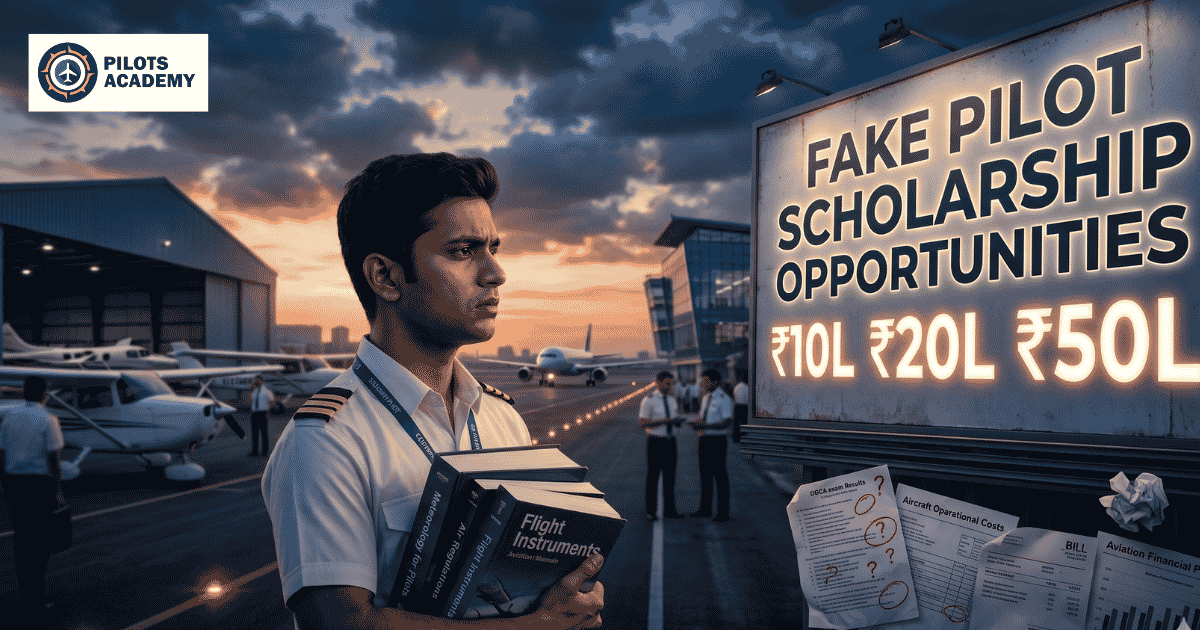
So when a private flying school or aviation institute advertises a scholarship worth ₹10 lakh,
₹20 lakh, or even ₹50 lakh, it naturally grabs attention. For a family planning a ₹70 lakh to ₹1 crore investment, a scholarship sounds like a blessing.
But this is exactly where aspiring pilots need to pause.
Not every scholarship claim is fake. But not every scholarship claim is genuine either.
In aviation, where the cost of one wrong decision can affect your finances for years, it is important to understand the difference between a real opportunity and a marketing promise designed to look attractive.
The Common Scholarship Claim
Many private flying schools and DGCA ground coaching institutes advertise offers like:
“Score 90% or above in all five DGCA subjects in your first attempt and receive a scholarship of ₹10 lakh, ₹20 lakh, or ₹50 lakh towards your flight training.”
On paper, this sounds incredible.
It gives students motivation. It gives parents hope. It makes the institute look confident, generous, and student-friendly.
But the real question is this:
How many students actually receive this scholarship?
That is where the truth usually becomes uncomfortable.
Why This Claim Should Raise a Red Flag
DGCA exams are not easy. A student has to clear subjects like Navigation, Meteorology, Air Regulations, Technical General, and RTR.
Scoring well in one subject is achievable with strong preparation. Scoring 90% or more in one subject is difficult, but possible.
But scoring 90% or above in all five subjects, that too in the first attempt, is extremely rare.
This is why such scholarship offers need to be examined carefully.
The offer looks big because the condition attached to it is almost impossible for most students to meet. The institute knows this. That is why the scholarship amount can be advertised so boldly.
In many cases, the scholarship is not designed to be claimed. It is designed to attract enquiries.
The Data Is Public. Students Should Check It.
One of the best things students can do is check DGCA exam results themselves.
DGCA results are publicly available and can be downloaded from the official DGCA website. Instead of believing what a brochure or counsellor says, students and parents should look at the actual numbers.
Check how many students score 90% or above in each subject. More importantly, check how many score 90% or above across all five DGCA subjects in the first attempt.
The number is extremely low.
Once you see the data yourself, the marketing promise becomes easier to understand.
It is not technically impossible. But for the overwhelming majority of students, it is practically out of reach.
And that is the point.
A scholarship that almost nobody can qualify for is not really financial support. It is a marketing hook.
Ground Class Scholarships Can Be Genuine
Now, this does not mean every scholarship in aviation is fake.
There is a big difference between a ground class scholarship and a flight training scholarship.
A ground coaching institute can genuinely offer discounts or scholarships. Why? Because their costs are relatively fixed.
They already have classrooms, instructors, online lectures, recorded content, and study material. Adding one or two extra students at a discounted fee does not dramatically increase their cost.
So if a DGCA ground school offers a genuine merit-based waiver or partial scholarship, it can be financially realistic.
For example, a coaching institute may reduce ₹20,000, ₹50,000, or even more from the ground class fee for a strong student. That is possible because the institute is not directly paying for aircraft fuel, airport charges, aircraft maintenance, or flight hours.
So yes, ground class scholarships can be real.
But flight training scholarships are a completely different matter.
Why Flight Training Scholarships Are Different
Flight training has hard costs.
Every hour in the aircraft costs money. There is fuel. There is aircraft maintenance. There is instructor time. There are landing charges, handling charges, airport fees, insurance costs, and operational expenses.
These are not imaginary costs. They cannot simply be waived because a student scored well in an exam.
So when a small or mid-sized private flying school says it will give ₹10 lakh, ₹20 lakh, or ₹50 lakh towards flight training, students should be careful.
Ask yourself honestly:
Can this institute genuinely absorb that cost?
For most small private institutes, the answer is no.
A flying school cannot fly aircraft for free. It cannot avoid fuel costs. It cannot skip maintenance. It cannot ignore regulatory and airport expenses.
That is why large flight training scholarships from small private institutes should always be questioned.
They may sound attractive, but financially, they often do not make sense.
Real Scholarships Usually Come From Strong Backers
There are genuine aviation scholarships, but they are usually backed by organisations that have the financial capacity to support them.
Examples may include charitable trusts, large CSR initiatives, government schemes, or established institutional funding programmes.
These organisations are different from small private institutes because they are built to fund education, support communities, or promote access to professional careers.
For example, scholarships supported by respected trusts, government initiatives, or
CSR-backed programmes can be genuine because the money is actually allocated for that purpose.
That is the difference.
A real scholarship has funding behind it.
A fake or misleading scholarship has marketing behind it.
Two Questions Every Student Must Ask
Before getting impressed by any private institute’s scholarship claim, ask two simple questions.
First:
How many students have actually received this scholarship in the past?
Do not accept vague answers like “many students” or “top performers.” Ask for names, batches, amounts awarded, and proof.
Second:
What percentage of your students actually qualify for this scholarship every year?
If the answer is unclear, that itself tells you something.
A genuine scholarship programme will have transparency. The institute should be able to show past winners, eligibility criteria, award details, and proof of disbursement.
If they cannot show this, treat the claim carefully.
Do Not Fall for Brochure Psychology
Aviation marketing often uses aspiration very well.
Beautiful aircraft photos. Pilot uniforms. Airline dreams. International training promises. And then, somewhere in the middle, a big scholarship amount.
This combination is powerful because it speaks directly to emotion.
Students see opportunity. Parents see financial relief. The institute gets attention. But aviation is not a career where decisions should be made emotionally.
This is a high-investment profession. Every rupee matters. Every promise must be checked. Every claim must be verified.
A brochure is not proof.
A counsellor’s pitch is not proof. A social media ad is not proof.
Only verified data, written terms, and actual past disbursement records matter.
The Red Flags to Watch Out For
A scholarship claim should be treated carefully if the conditions are unrealistic, the institute refuses to share past winner details, the scholarship is only mentioned verbally, or the offer is being used mainly to push you into quick admission.
Also be careful if the institute says things like:
“You are a bright student, you can easily get this.”
That line may sound encouraging, but it can also be a sales tactic.
A serious aviation institute should help you understand both the opportunity and the difficulty. It should not make impossible conditions sound easy just to close an admission.
The Honest Bottom Line
Pilot training scholarships by private institutes are not always fake, but many big scholarship claims need to be questioned.
Ground class scholarships can be genuine because the cost structure allows it.
But large flight training scholarships from small private institutes are often unrealistic because flying has unavoidable hard costs.
Before trusting any scholarship claim, students should check the DGCA result data, ask for proof of past scholarship winners, and understand whether the institute actually has the financial capacity to fund what it promises.
Aviation is a dream, but it is also a serious financial decision.
So do not choose an institute because of a scholarship headline.
Choose it because the training is transparent, the costs are clear, the claims are verifiable, and the institute is honest about the journey ahead.
In aviation, the best scholarship is not the biggest number printed on a brochure. It is the truth given to you before you invest your family’s money.