
Air India Cadet Program Selection Process (Firsthand Intelligence)
- No Simulator round
- 3 emergency scenarios verbally
- Structured CRM answers
How to Become a Pilot — Two Pathways
There are two primary routes to becoming a commercial airline pilot: the Cadet Pilot Programme and the Conventional CPL route.
In a cadet programme, the airline selects candidates before the main training begins. In the conventional route, the candidate completes medicals, DGCA examinations and flight training independently before applying for airline vacancies.
Cadet Pilot Programme
The airline evaluates and selects candidates before training. Selected cadets then progress through ground school, Commercial Pilot Licence training and aircraft type rating according to the programme structure.
- Airline screening takes place before training.
- Training follows a structured airline-linked pathway.
- Payments are generally linked to training milestones.
- Type rating is based on the airline’s fleet requirements.
- Successful completion may lead to an employment offer, subject to the airline’s requirements and programme terms.
Conventional CPL
The candidate independently completes DGCA medicals, eGCA registration, ground examinations and approximately 200 hours of flight training before applying for available airline vacancies.
- The candidate selects the flying school and training country.
- Financing and training arrangements are managed independently.
- Foreign licences require DGCA conversion before flying in India.
- Type rating may need to be funded separately.
- Completing a CPL does not guarantee an airline vacancy.
Cadet Pilot Programme vs Conventional CPL
| Criteria | Cadet Pilot Programme | Conventional CPL |
|---|---|---|
| Selection | Airline screening takes place before training begins. | The candidate completes training first and applies for airline vacancies later. |
| Training Structure | A structured, airline-linked training programme. | The candidate independently manages each stage of training. |
| Cost Structure | Payments are generally linked to defined training milestones. | The total cost depends on the selected flying training organisation and training country. |
| Type Rating | Usually included in the programme or linked to the airline’s fleet requirements. | Frequently completed and funded separately after obtaining the CPL. |
| Career Outcome | Provides an airline-linked career pathway after successful completion, subject to programme and airline requirements. | Completing the CPL does not guarantee an airline vacancy or employment offer. |
Conventional CPL — Cost & Country Snapshot
The cost and timeline of conventional flight training depend on the country, flying school, exchange rate, accommodation, aircraft availability and DGCA licence-conversion requirements.
The figures below are indicative estimates from the source document and must be reverified before publication.
| Route / Country | Licence | Flying Hours | Duration | Total Cost (Approx.) | DGCA Conversion |
|---|---|---|---|---|---|
| Royhle — Philippines | PPL / CPL / IR / ME (CAAP) | 220 hours | 12–14 months |
USD 61,500 Approximately ₹54.6 lakh |
Yes |
| Aviation Junction — South Africa | PPL / CPL / ME / IR (SACAA) | 200 hours | Approximately 12 months |
ZAR 9.6 lakh Approximately ₹52.8 lakh |
Yes |
| NZAA — New Zealand | PPL / CPL (CAA New Zealand) | 200 hours | 10 months |
NZD 115,000–135,000 Approximately ₹62–73 lakh |
Yes |
| India — Conventional FTO | PPL / CPL (DGCA) | Minimum 200 hours | 18–24 months |
₹55–85 lakh All-inclusive average |
No — Direct |
| USA — Part 141 | PPL / CPL / IR / ME (FAA) | 190–250 hours | 12–18 months |
USD 70,000–110,000 Approximately ₹62–98 lakh |
Yes |
| Europe — EASA Integrated | CPL / IR / ME with Frozen ATPL | 195–220 hours | 18–24 months |
EUR 45,000–140,000 Approximately ₹42 lakh–₹1.3 crore |
Yes |
Important: Foreign-trained pilots from the Philippines, South Africa, New Zealand, the USA or Europe must complete the applicable DGCA licence-conversion requirements before flying for an Indian airline. This may add approximately ₹8–15 lakh and 3–6 months after returning to India.
Costs and INR conversions are approximate and can change with exchange rates, flying-school charges, accommodation, aircraft availability and additional training requirements. Always reconfirm the current quotation, inclusions, exclusions and conversion expenses directly with the relevant flying training organisation before making a financial decision.
Eligibility Criteria
-
Age
18–30 years Applicants should fall within the permitted age range at the time of application.
-
Education
Minimum 60% in 10+2 Applicants require at least 60% in Class 12, including at least 60% individually in: English Mathematics Physics NIOS qualifications are accepted, subject to meeting the required marks.
-
Medical
DGCA Class 1 Medical Candidates must clear the applicable DGCA medical requirements before starting flight training.id certificate required
-
Passport
Valid Indian Passport • No travel restrictions
-
English
Strong written and spoken English Candidates should be able to communicate clearly throughout online assessments, group exercises and interviews.
-
Nationality
Citizen of India or OCI Eligibility should be checked against the instructions published for the applicable intake.
US Program (~₹1.5–1.6 Cr) ongoing.
Follow @pilots_academy_ for batch opening alerts.
Selection Process Overview
Based on recent candidate intelligence, the Air India cadet selection process begins with an online aptitude and psychometric assessment, followed by in-person group and interview rounds.
Online Aon / Cut-E Assessment
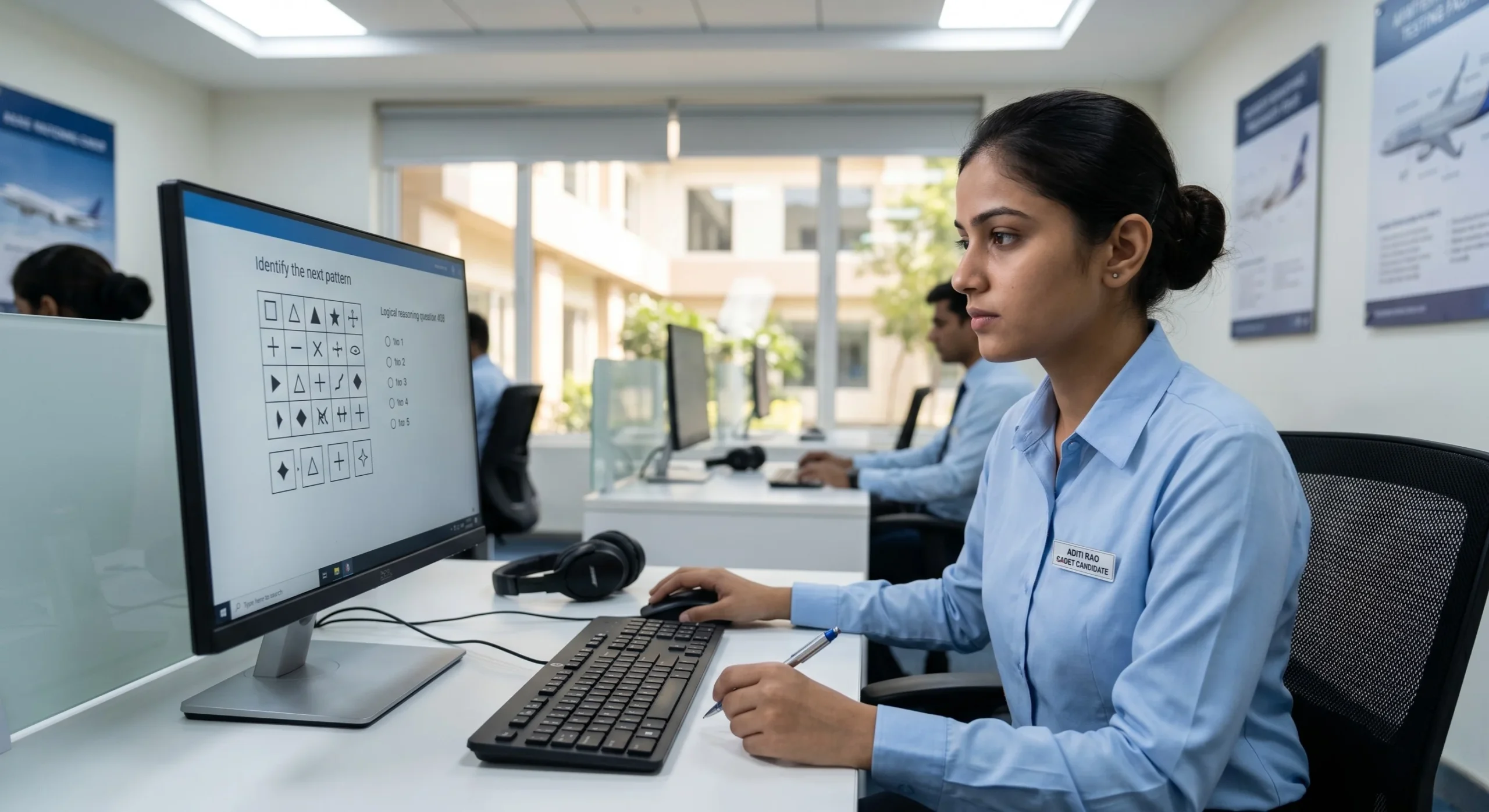
Online psychometric and aptitude assessment
- Conducted online before the in-person selection rounds.
- Includes eight assessment modules.
- Approximately 84 minutes in total.
- A video tutorial is generally provided before each module.
- Tests personality, numeracy, English, multitasking, coordination, monitoring, reaction speed and spatial orientation.
Group Discussion
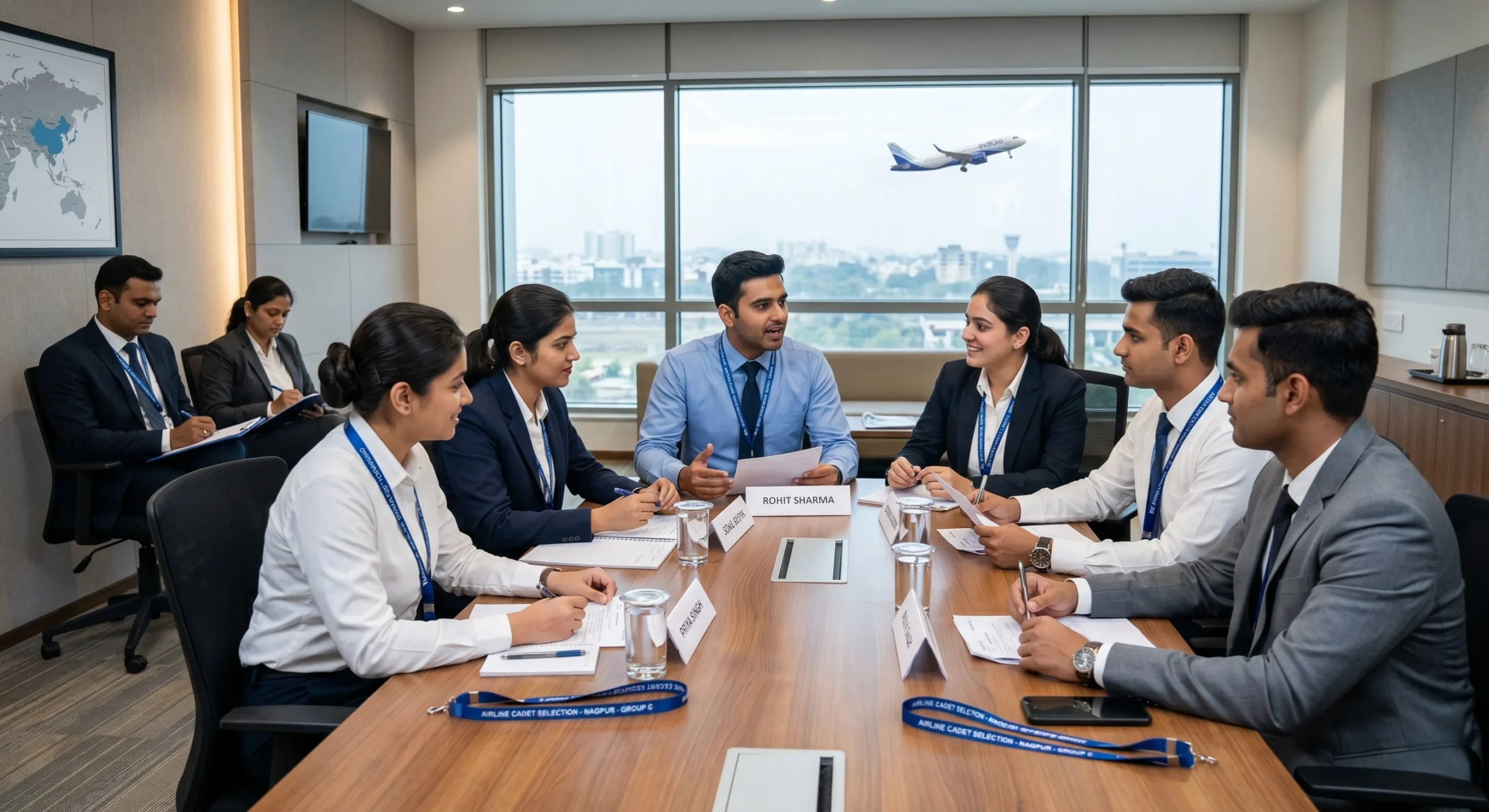
In-person panel-observation round
- Each candidate gives a brief self-introduction.
- A discussion topic is assigned to the group.
- Candidates are expected to share their views clearly.
- The panel observes communication and listening ability.
- Collaboration, confidence, teamwork and composure are assessed.
Psychologist / ELP Interview
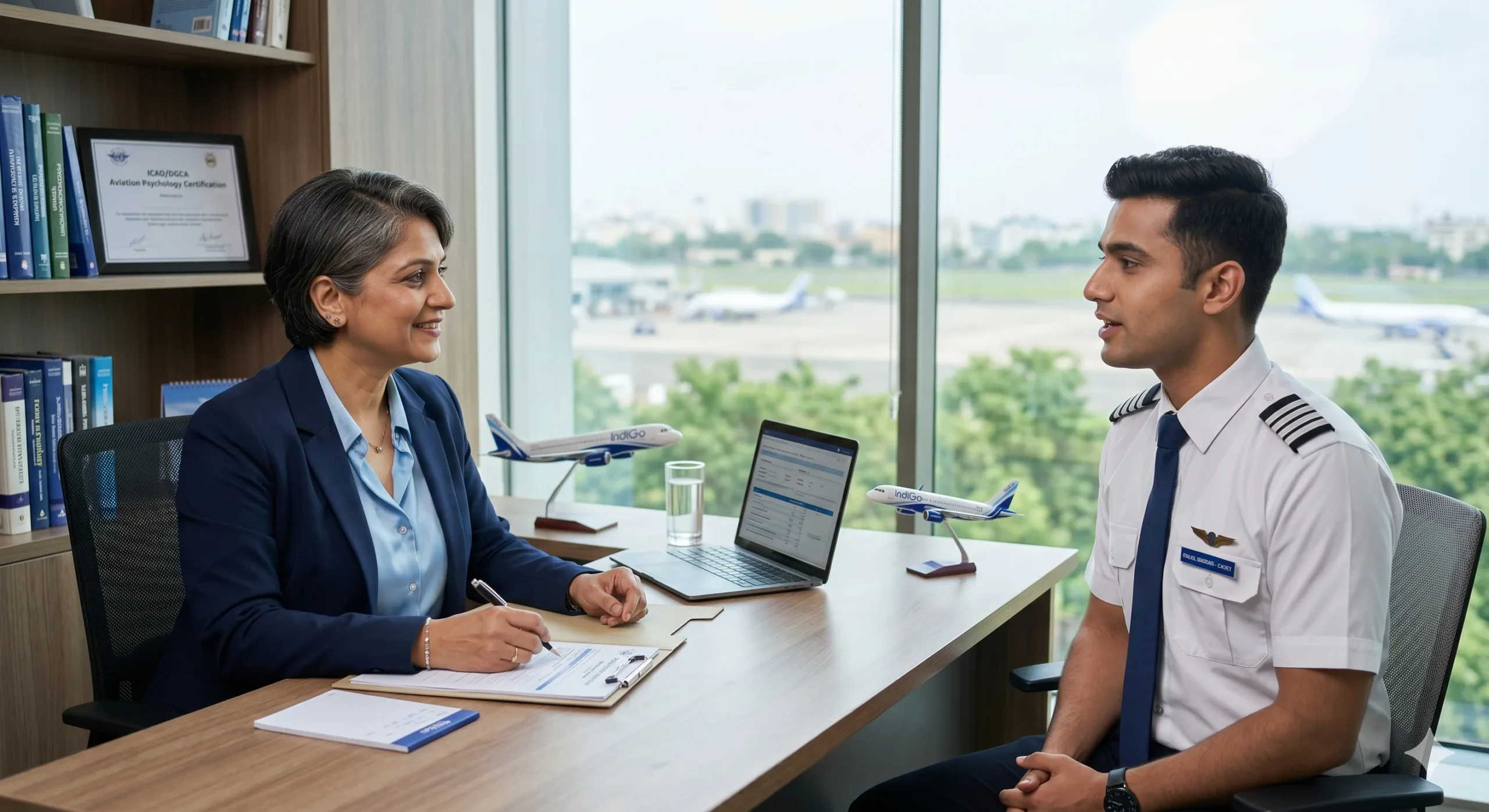
One-on-one competency-based interview
- Candidates are asked behavioural and competency-based questions.
- Real personal examples are expected in the answers.
- Teamwork, leadership and resilience are assessed.
- Situational awareness and decision-making are evaluated.
- Workload management, communication and emotional control may also be examined.
HR Panel Interview
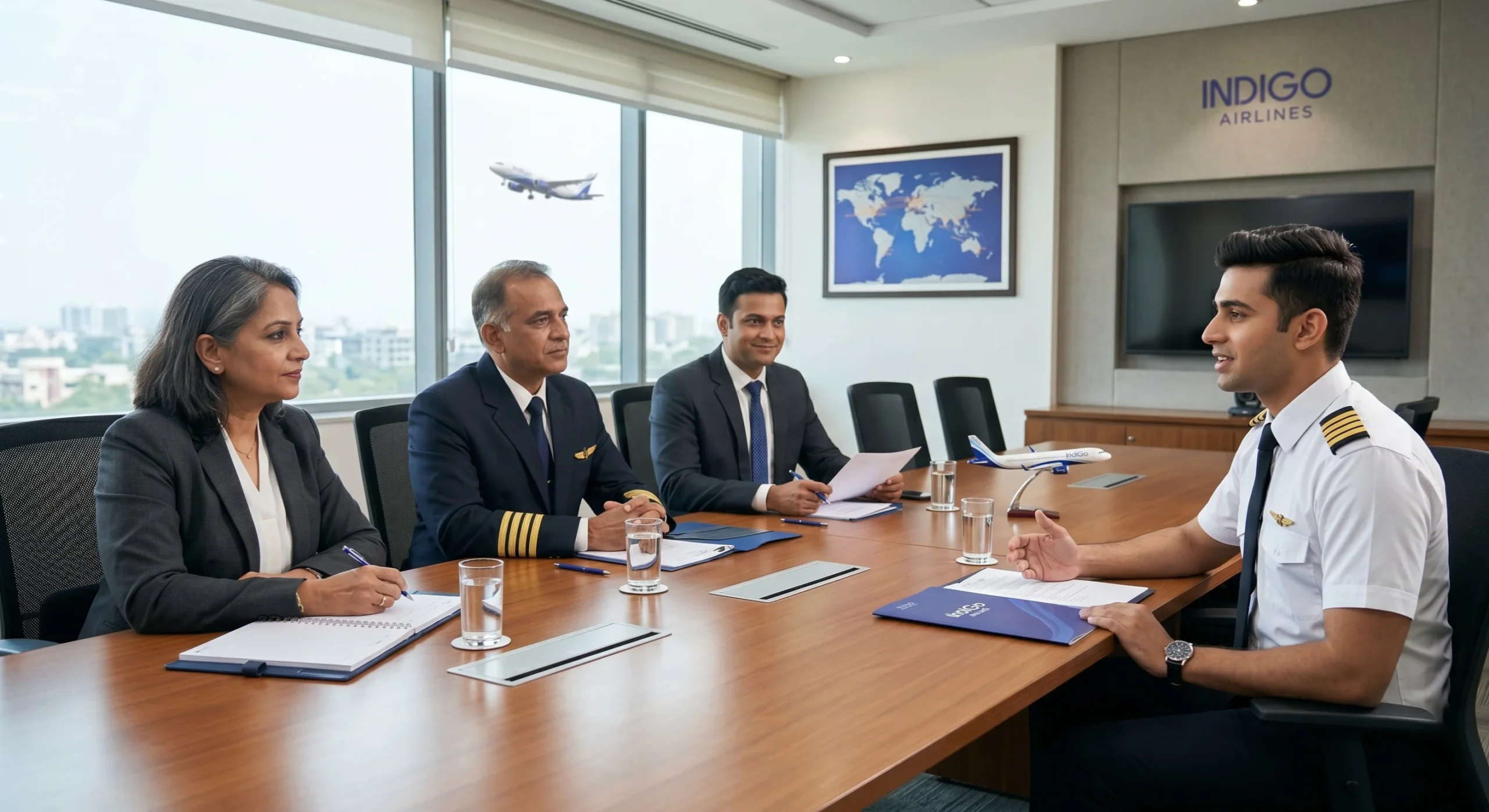
In-person panel interview
- Personal background and motivation questions.
- Air India-specific questions, including family support.
- Physics and general technical questions.
- Questions from DGCA subjects already studied or cleared.
- Three emergency scenarios are reportedly tested verbally.
Stage 1 — Aon / Cut‑E Written Exam
- 8 modules
- ~84 minutes total
- Topic assigned
- 8 modules
- ~84 minutes total
- Topic assigned
-
Personality (ADEPT‑15)
Untimed • no right/wrong • ~25 min
-
Applied Numeracy
Unit conversion, % , areas & spaces • ~20 min
-
English Proficiency
Fluency, vocabulary, spelling • ~13 min
-
Multitasking
Multiple tasks under time pressure • ~7 min
-
Hand‑Eye Coordination
Joystick-style control (wingChallenge) • ~6 min
-
Monitoring Ability
Track/count moving objects (scales cmo) • ~5 min
-
Reaction Speed
Alertness to stimuli (scales rt drv) • ~5 min
-
Spatial Orientation
Locate yourself/objects relative to environment • ~3 min
Numeracy (~20 min) and Personality (~25 min) are the longest modules. Practise mental maths daily. Review ADEPT‑15 sample questions— inconsistency can be flagged automatically.
Stage 2 — Group Discussion
- In-person
- Panel observation
- Topic assigned
- In-person
- Panel of interviewers
- Two sub-rounds with the panel
- Covers 5 question categories
- Real questions from recent rounds
- 3 emergency scenarios tested verbally (no simulator)
Tata Group motto —running fast vs running far
(link to CRM, cockpit teamwork)
Stage 3A — Psychologist / ELP Round
- One-on-one
- competency-based behavioral questions
- real patterns from recent rounds
Core Competencies Assessed
- Teamwork
- Leadership
- Resilience
- Situational Awareness
- Decision Making
- Workload Management
- Teamwork
- Leadership
- Resilience
- Situational Awareness
- Decision Making
- Workload Management
Core Competencies Assessed
-
Q1 • SELF + MOTIVATION
Tell me about yourself. Why do you want to be a pilot?
Structure: background → aviation journey → why this career. Avoid generic “I love flying”.
-
Q2 • THINKING ABILITY
What is the difference between knowledge and wisdom?
Apply to aviation: knowing procedures vs when/how to apply judgment beyond procedures.
-
Q3 • PILOT MINDSET
Why is the right mindset critical for a pilot?
Link to SA, CRM, and decision-making under pressure (use a real example if possible).
-
Q4 • EMOTIONAL REGULATION
How do you handle anger? What if the pilot next to you gets angry?
CRM: acknowledge emotion, de-escalate, focus on the task. Never react aggressively.
-
Q5 • COMPETENCY-GENERAL
Tell me about a time when you had to make a difficult decision under pressure.
Use STAR format: Situation, Task, Action, Result. Prepare 2–3 real stories showing calm, structured thinking.
These are competency-based questions. Give specific real examples,
“Tell me about a time when…” is the expected format.
Stage 3B — HR Panel Interview
- In-person
- Panel of interviewers
- Two sub-rounds with the panel
- Covers 5 question categories
- Real questions from recent rounds
- 3 emergency scenarios tested verbally (no simulator)
Calm under pressure • correct priority order • structured thinking • CRM mindset • aviation vocabulary.
- Tell me about yourself — in detail. Why do you want to be a pilot?
- What is your biggest weakness, and how are you working on it?
- What motivates you? What is the most difficult thing about being a pilot?
- Air India specific: Why Air India specifically?
- Who is the head of your family? Do they support your decision to be a pilot?
- State and explain Ohm’s Law / Newton’s Laws
- Favourite aircraft — range and service ceiling
- Most advanced & safest aircraft in operation today — and why?
- DGCA: METAR, TAF, types of fog, western disturbance, current weather context
- Other papers: subject-specific questions based on DGCA papers you cleared
No Simulator Round + Get a Preparation Plan
Emergency handling is tested verbally in Stage 3B through three structured scenarios.
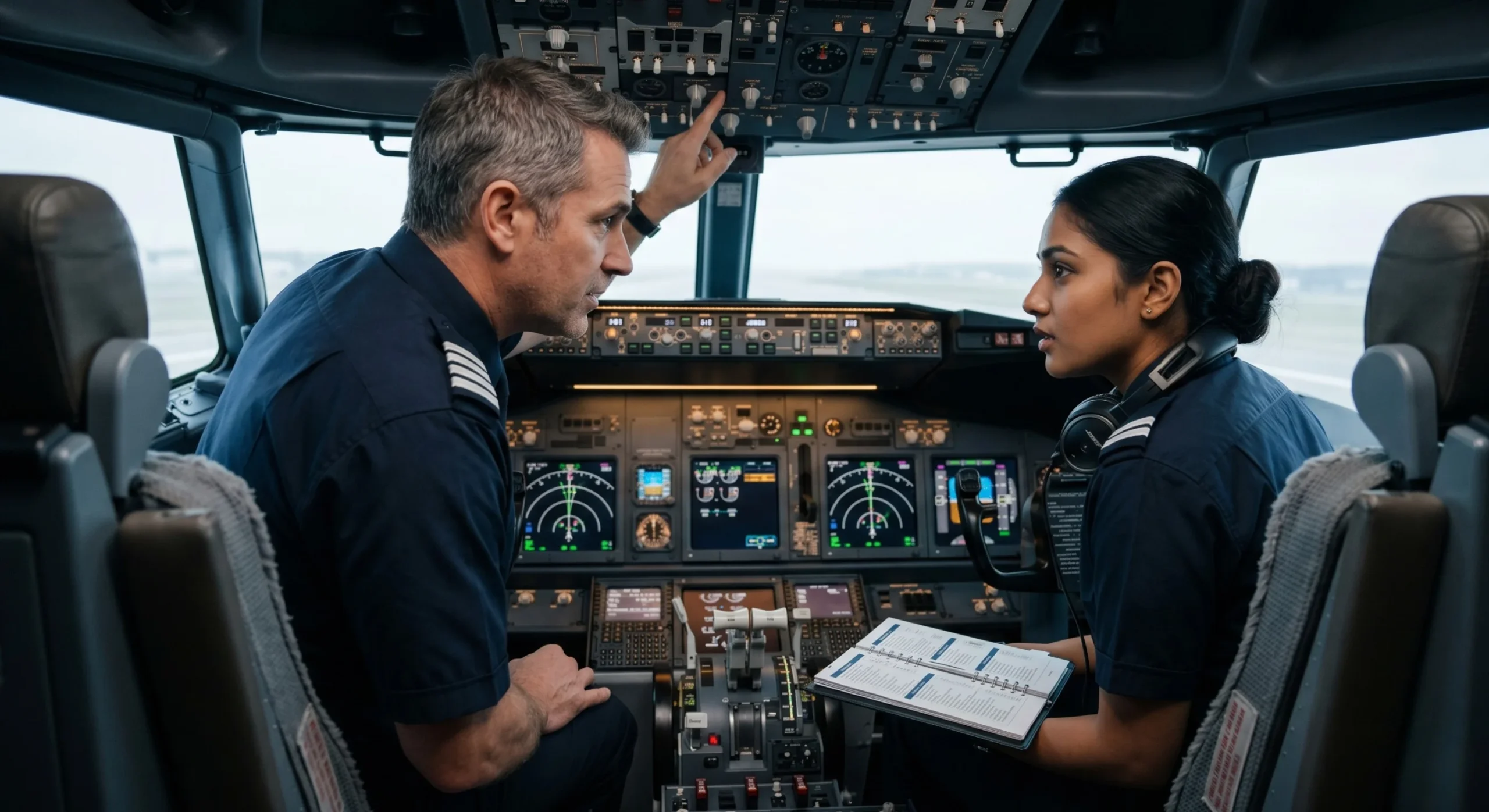
Important
Emergency handling is verbal in Round 3B (HR Panel), not through a simulator. Always start with
- AVIATE
- NAVIGATE
- COMMUNICATE
- Calm under pressure
- Structured thinking
- Aviation vocabulary
- No hesitation
Emergency Scenarios (3) — Tested Verbally in Stage 3B
Scenario 1 :
Medical emergency in flight
- Aviate first
- Assign crew roles
- Declare emergency
- Divert to nearest suitable airport
- Coordinate with cabin crew and ground medics via radio
Scenario 2 :
Engine failure in flight
- Aviate → Navigate → Communicate
- Maintain control first
- Identify the failure
- Apply memory items
- Declare Mayday
- Divert (don’t rush past control phase)
Scenario 3 :
Windshield crack or fog in flight
- Do not panic
- Maintain control
- Assess severity
- Reduce speed if needed
- Declare emergency and divert
- For fog: check pressurisation and heating systems
Calm under pressure • correct priority order • CRM mindset • structured thinking • aviation vocabulary • no hesitation.
Core Values Assessed — Across Every Round
Airline selection panels evaluate more than technical knowledge. The same underlying professional qualities can be observed during an aptitude assessment, Group Discussion, Psychologist / ELP Interview and HR Panel Interview.
Teamwork
Can you function effectively as part of a crew? The panel looks for candidates who support others, share important information and work towards a collective goal.
Leadership Skills
Do you understand when to lead and when to follow? Candidates should be able to take responsibility calmly under pressure without ignoring or overriding others.
Communication Skills
Are you clear, structured and confident when you speak? The panel also observes whether you listen carefully before responding.
Self-Confidence
Do you believe in your decisions? Confidence should appear steady and professional, not arrogant, boastful or dismissive.
Motivation to Join Aviation
Is your reason for joining aviation genuine and specific? Experienced interview panels can quickly identify generic or rehearsed motivation answers.
General Aviation Knowledge
Candidates should understand basic aircraft principles, instruments, phases of flight and the responsibilities associated with professional aviation.
Adaptability
Can you adjust to unfamiliar environments, changing information and unexpected situations without losing composure?
Decision Making
Can you evaluate available information, consider risk and commit to a safe and logical decision while working under pressure?
Resilience
Have you faced setbacks, and how did you respond? Panels look for candidates who learn from difficulties, recover constructively and continue improving.
You can prepare for the questions, but you cannot fake who you are. Strengthen these values genuinely through the way you speak, carry yourself, respond to setbacks and make decisions every day.
Quick Comparison — Air India vs IndiGo vs Air Arabia
A stage-by-stage snapshot of how Air India’s selection process compares with IndiGo and Air Arabia, based on recent candidate intelligence.
| Stage | Air India | IndiGo | Air Arabia |
|---|---|---|---|
| Platform | Aon (Cut-E) — 8 modules, approximately 84 minutes | Symbiotics ADAPT — 8 modules, approximately 300-question personality assessment | Symbiotics ADAPT — same as IndiGo, plus an extended Flight Test |
| Stage 2 | Group Discussion — self-introduction and leadership topic | Group Discussion — any topic or data case study | ELP Interview (one-on-one) — English language and articulation |
| Stage 3 | Psychologist / ELP and HR panel — Physics, DGCA and situational questions | Single personal interview — aviation knowledge and mental mathematics on the spot | Panel interview — HR, relocation question and Technical PPT evaluation |
| DGCA Papers | Extensively asked — Met questions most common | Deep dive on whichever papers you have cleared | Not the primary focus — the technical PPT replaces this |
| Simulator | None — emergencies are tested verbally in Stage 3B | Full Flight Simulator module within ADAPT during Stage 1 | Extended Flight Test — more demanding than IndiGo’s |
| Unique Element | Family-support question and 3 verbal emergency scenarios | Live mental mathematics and an FTO-specific knowledge check | 9-topic technical PPT, approximately 10 minutes each, and a Sharjah relocation question |
Important: This comparison is based on firsthand intelligence from recent candidates and is provided for preparation guidance only.
Air India vs IndiGo — Training Pathways Compared
Compare the officially listed training pathways, partner schools, programme structure, fee-disclosure method and intake-status requirements before making a financial decision.
Air India
Air India currently lists its Flying Training Academy in Amravati and two United States partner schools for CPL training. Type Rating is arranged through Air India-affiliated Approved Training Organisations according to fleet requirements.
IndiGo
IndiGo currently lists several domestic and international training partners. The applicable location, fee structure, intake availability and training timeline depend on the partner programme selected.
| Programme | Training Partner / Track | Training Location | Programme Structure | Cost Display | Current Status |
|---|---|---|---|---|---|
| Air India | Air India Flying Training Academy Air India’s domestic CPL training pathway | Amravati, Maharashtra, India | CPL training through the Air India academy, followed by Type Rating through an Air India-affiliated ATO according to fleet requirements. | Training cost shared after enrolment and before commencement of training | Upcoming Opportunities |
| Air India | AeroGuard Flight Training Center United States partner-school pathway | Phoenix, Arizona, United States | CPL flying training at the assigned partner facility, followed by Air India Type Rating according to fleet requirements. | Applicable fee and milestone-payment plan disclosed for the selected intake | Verify Current Intake |
| Air India | Acron Aviation Academy United States partner-school pathway | United States | CPL flying training through the assigned partner facility, followed by Air India Type Rating according to operational and fleet requirements. | Applicable fee and payment plan disclosed for the selected intake | Verify Current Intake |
| IndiGo | Skyborne Airline Academy International cadet pathway | Vero Beach, Florida, United States | Airline-selected cadet pathway covering CPL training and the applicable Airbus A320 Type Rating route. | Contact the training partner for the latest complete fee quotation | Officially Listed Partner |
| IndiGo | Flight Training Adelaide International cadet pathway | Australia | Partner-specific CPL training followed by the applicable Airbus A320 Type Rating pathway. | Obtain the current written fee breakdown from the official training partner | Verify Current Intake |
| IndiGo | Insight Aviation IndiGo-approved training pathway | Confirm with the partner for the applicable intake | Partner-managed CPL training followed by the applicable Airbus A320 Type Rating pathway. | Contact the official partner for the latest verified fee | Verify Current Intake |
| IndiGo | Chimes Aviation Academy Domestic cadet training pathway | India | Partner-managed CPL training followed by the applicable Airbus A320 Type Rating pathway. | Request an all-inclusive written quotation from the official partner | Verify Current Intake |
| IndiGo | Garuda Aviation IndiGo-approved cadet pathway | Confirm with the partner for the applicable intake | Partner-specific CPL training followed by the applicable Airbus A320 Type Rating pathway. | Contact the official partner for the latest fee and payment schedule | Verify Current Intake |
| IndiGo | Marigold IndiGo-approved cadet pathway | Confirm with the partner for the applicable intake | Partner-specific CPL training followed by the applicable Airbus A320 Type Rating pathway. | Obtain the current all-inclusive quotation directly from the partner | Verify Current Intake |
The Takeaway for Families
The practical decision should be based on verified total cost, training location, intake availability and contract terms—not only the airline name.
Air India Pathway
Air India offers a structured airline-linked route in which CPL training and Type Rating are organised through its academy or assigned partner schools. The applicable training location and intake depend on programme allocation.
IndiGo Pathway
IndiGo currently provides a wider choice of listed training partners. This can give families more flexibility in training location, fee structure and partner-specific programme availability.
Compare the complete financial commitment, including:
- Training tuition
- Accommodation and meals
- Visa and international travel
- DGCA medical expenses
- Examination and licence fees
- Additional flying hours
- Licence conversion expenses
- Aircraft Type Rating
- Refund and service-commitment terms
Important: Programme fees, training partners, locations and intake status can change without notice. Do not hard-code open or closed status permanently. Update the status and “Last verified” date through WordPress custom fields, and always confirm the final quotation directly with the airline or official training partner before a candidate makes any payment.