Pilot Salary in India 2026: Monthly Pay by Airline and Rank
A career-stage breakdown of cadet vs conventional pathways, airline pay scales and flying allowances — written by an active airline Commander with 6,000+ hours.
Updated October 2026
Written by Captain Akhil — 6,000+ hours of flying experience, former Commander with Jet Airways, SpiceJet and Vistara
Indian airline pilots earn ₹50,000/month during training, ₹2.35–3.45L/month as First Officers, and ₹7.5–10L/month as Captains. IndiGo commits CTC at 70 hours; Air India/Akasa fix pay at 40 hours plus hourly flying allowance. Senior training captains and international roles can reach ₹15–20L/month tax-free.
₹2.35L+
Released FO Salary (p.m.)
₹8.9L
Sr. Captain CTC (IndiGo)
30,000+
Pilots Needed (next decade)
₹20L
Peak Monthly Earning
Pilot Salary in India per Month: 2026 Snapshot
Here is what an airline pilot in India earns each month at every stage of the career, taken from the airline pay scales covered in detail below. Use it as a quick guide; the sections that follow explain how each airline calculates pay.
Career Stage
Typical Monthly Pay
What the Range Covers
Trainee / Junior First Officer (under training)
₹50,000 (stipend)
Air India Express stipend during ground, simulator and line training
Fresher First Officer (first year after release)
₹2.35–2.67 lakh
Air India Express JFO ₹2.35L; IndiGo FO (under 1,000 hrs) ₹2.67L CTC
First Officer (1+ year)
₹2.6–3.45 lakh
Akasa ₹2.6L fixed; IndiGo ₹3.37L (over 1,000 hrs); Air India Express ₹3.45L
Senior First Officer
₹3.4–4.85 lakh
Akasa ₹3.4L fixed; IndiGo ₹4.85L
Captain
₹4.75–8.42 lakh
Air India Express ₹4.75L; Akasa ₹5.5L fixed; IndiGo ₹8.15–8.42L
Senior Captain / Commander
₹6.25–8.91 lakh
Akasa ₹6.25L fixed; Air India Express ₹7.5–8.5L; IndiGo ₹8.91L
Training Captain (LTC / TRI)
₹9.77–10.5 lakh
IndiGo check and instructor pay scales
International Captain
Up to ~3x India pay, tax-free
Emirates, Qatar Airways, Etihad and Saudi carriers
Akasa figures are fixed pay for 40 hours, before hourly flying allowance. IndiGo figures are CTC committed at 70 hours. Air India Express figures assume 70 flying hours a month. An individual pilot’s pay depends on the airline, aircraft type and hours flown.
A fresher pilot does not start earning on the day they get a DGCA Commercial Pilot Licence (CPL). Training takes roughly 18 to 24 months, and pay starts once you join an airline. From there, pay moves in two steps:
During airline training: a stipend of about ₹50,000 to ₹1 lakh a month while you complete ground, simulator and line training, depending on the airline.
Once released as a First Officer: about ₹2.35–2.67 lakh a month in your first year at Air India Express or IndiGo.
Smaller operators pay less at the start. Star Air, for example, pays First Officers about ₹1.05–1.45 lakh a month in their first 500 hours. Pilots who take the instructor route start at around ₹1.5 lakh a month as an Assistant Flight Instructor.
Most airlines also hold a newly released First Officer to a bond of around five years, so the first years are about building hours and clearing the ATPL, which is what opens the door to a Captain’s salary.
Air India Pilot Salary: Air India & Air India Express
Air India and Air India Express run near-identical pay structures, and this is where most cadet aspirants have the most misconceptions. Salary isn’t a single number, it moves in stages tied to training status, experience, and licence upgrades, and both airlines fix pay against 40 hours of flying a month rather than the 70-hour benchmark some other carriers (like IndiGo) use.
When a cadet joins, they enter as a Junior First Officer under training. This training window covers:
Ground training and simulator training
Base training: three take-offs and landings on an empty aircraft
Line training: roughly 100 hours or 70 sectors, split between pilot flying and pilot monitoring duties
A final competency check before being “released” as a functioning First Officer
Through this entire window the cadet draws a fixed stipend, with layover costs, training allowances, airport transport, and insurance all covered separately by the airline. Progression to Captain after that requires two things:
Clearing the Airline Transport Pilot Licence (ATPL) exam, the advanced licence above the CPL that is mandatory to become Pilot-in-Command
A minimum of 1,500 flying hours, which typically takes about two years at an average of 600–700 flying hours annually
Even once eligible, movement to Captain and then Senior Commander depends on cockpit vacancies opening up within the airline, not just eligibility.
Career Stage
Description
Monthly Pay (assumes 70 hrs)
Junior First Officer (Under Training)
Ground + sim + base + line training, pre-release
₹50,000 (stipend)
Junior First Officer (Y1)
Released FO, up to 1 year post-release
₹2,35,000
First Officer
1+ year after line release
₹3,45,000
Captain (SFO)
First Officer holding ATPL
₹4,75,000
Commander
Internally upgraded, P1-rated on type
₹7,50,000
Sr. Commander
4+ years of P1 rating on type
₹8,50,000
Source: Air India Express Pay & Allowances circular (Ref: AIEXPRESS/HR/6631, effective 1 April 2023). Air India runs a comparable structure. Figures assume 70 flying hours/month; fixed pay itself is protected at 40 hours.
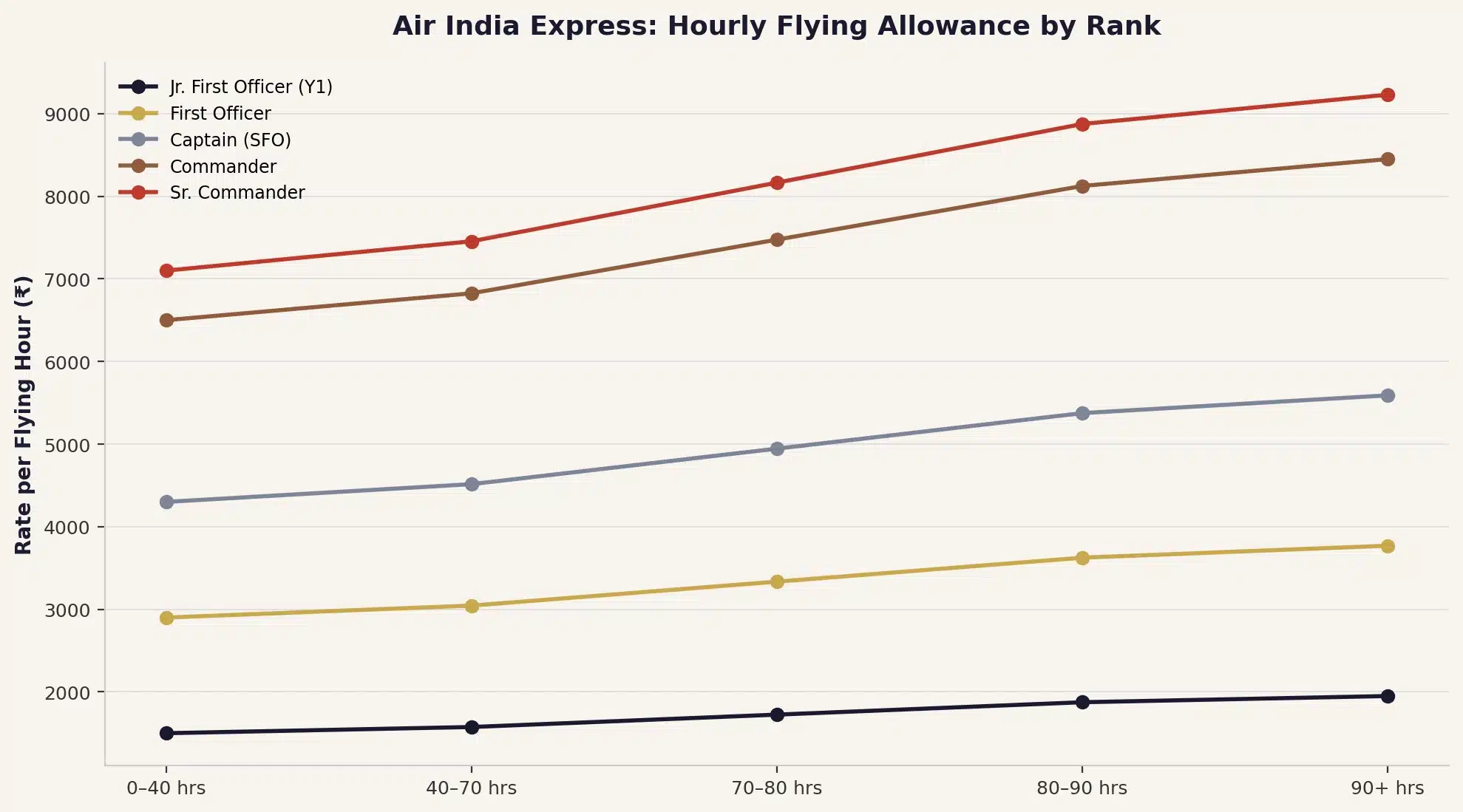
Hourly Flying Allowance (Beyond the 40-Hour Fixed Pay)
Fixed pay in Air India and Air India Express covers the first 40 hours flown in a month. Every hour beyond that is paid at an hourly flying rate that increases in slabs, so a pilot who flies more in a given month earns meaningfully more than the fixed-pay figure alone suggests.
Level
0–40 Hrs
40–70 Hrs
70–80 Hrs
80–90 Hrs
90+ Hrs
Jr. First Officer (Y1)
₹1,500
₹1,575
₹1,725
₹1,875
₹1,950
First Officer
₹2,900
₹3,045
₹3,335
₹3,625
₹3,770
Captain (SFO)
₹4,300
₹4,515
₹4,945
₹5,375
₹5,590
Commander
₹6,500
₹6,825
₹7,475
₹8,125
₹8,450
Sr. Commander
₹7,100
₹7,455
₹8,165
₹8,875
₹9,230
Rates per flying hour, in ₹. Source: Air India Express circular, effective 1 April 2023.
Other Allowances Worth Knowing About
Beyond fixed pay and hourly flying allowance, a working airline pilot’s payslip carries a few recurring line items that materially affect take-home pay:
International Layover Allowance: a per-diem for nights spent on rostered international layovers, broadly in the $150–200 per night range, with airline-specific circulars governing exact city-wise rates.
Domestic Layover Allowance: ₹1,600 per night for JFO/FO/Captain, and ₹2,200 per night for Commander/Sr. Commander on rostered domestic layovers.
Staff on Duty (SOD): if a pilot must be positioned as a passenger to operate a flight from a different base (say, a Delhi-based pilot repositioning to Kolkata to fly a sector out of there), that repositioning is paid at 65% of the applicable flying allowance rate for those block hours.
Management Allowance: ₹55,000 per month for senior commanders taking on executive/management-cadre duties alongside flying.
Trainer Allowances: Check Allowance (LTC): ₹50,000/month + 1.25% of the flying rate per hour of trainer duty; Instructor Allowance (TRI): ₹1,00,000/month + the same 1.25% component; Examiner Allowance (DE): ₹1,50,000/month + 1.25% per hour of trainer duty performed.
During training itself, everything — layover costs, training allowances, transport to and from the airport, and insurance — is covered separately by the airline and doesn’t come out of the trainee’s stipend.
Getting Paid During Command Upgrade & Type Conversion
Pilots undergoing command upgrade or aircraft conversion training don’t fly the line during that period, so airlines compensate separately for time spent in ground and simulator training. The rules:
Additional pay only kicks in once a pilot has spent at least 10 days in a month on training
It’s calculated using the 0–40 hour flying allowance rate
It’s capped by a maximum number of eligible training days depending on the upgrade or conversion (e.g. 22 days for a B737 FO to B737 Captain upgrade, versus 71–75 days for cross-fleet conversions like B737 to B777 or B787)
Exceeding the cap requires special sign-off from the COO and CHRO
In simple terms, total monthly pay during this phase = fixed pay + flying allowance for any actual hours flown beyond 40 + a training-day component equal to 3 block hours of flying pay for each day spent in training.
Akasa Air Pilot Salary: Pay Scale and Hourly Rates
Akasa Air, the newer low-cost entrant that has moved quickly on both fleet size and cadet hiring, structures its Flight Deck Crew pay differently, its fixed salary is benchmarked to 40 hours, similar to Air India Express, but its post-40-hour hourly rates and projected monthly pay at higher flying hours run higher across most levels.
Level
Fixed Salary (40 Hrs)
Hourly Rate (Post-40)
Projected @ 60 Hrs
Projected @ 80 Hrs
Trainee Captain
₹4,30,000
₹5,000
₹5,30,000
₹6,30,000
First Officer (FO)
₹2,60,000
₹3,045
₹3,20,900
₹3,81,350
Senior FO
₹3,40,000
₹4,515
₹4,30,300
₹5,20,600
Transition Captain
₹5,50,000
₹7,500
₹7,00,000
₹8,75,000
Sr. Transition Capt.
₹6,25,000
₹7,500
₹7,75,000
₹9,60,000
Source: Akasa Air internal Flight Deck Crew salary structure, effective 1 July 2023 (“Private and confidential, Proprietary to Akasa Air”). Figures rounded from the original slide; hourly post-70-hour rates step up further (₹10,000–11,000 for Captain-level roles).
The comparison matters less for picking one airline over another on salary alone — hiring cycles, fleet growth, and base locations all move the real decision — and more for a simple point: pay structures across Indian carriers are now converging around similar mechanics (fixed pay for 40 hours, tiered hourly rates beyond that), even where the absolute numbers differ.
IndiGo Pilot Salary: Committed Pay for 70 Hours
IndiGo is the outlier on structure among the three carriers covered here, instead of a 40-hour fixed-pay base topped up by hourly flying allowance, IndiGo commits to a monthly CTC benchmarked directly against 70 hours of flying, and pay steps up with total flying hours logged (crossing 1,000 hours, then 2,500 hours) rather than purely with rank. It also separates out its Check Airman (LTC) and Instructor (TRI) pay scales as distinct, higher CTC tiers above Senior Captain.
Captain & Above (Line Released)
Monthly CTC (6E Prime, 30 Days’ PL)
Captain (<1,000 Hrs)
Captain (>1,000 Hrs)
Sr. Captain (>2,500 Hrs)
LTC
TRI
Monthly CTC
₹8.15 Lac
₹8.42 Lac
₹8.91 Lac
₹9.77 Lac
₹10.5 Lac
SFO & Below (Line Released)
Monthly CTC
First Officer (<1,000 Hrs)
First Officer (>1,000 Hrs)
Senior First Officer
Monthly CTC
₹2.67 Lac
₹3.37 Lac
₹4.85 Lac
Source: IndiGo internal Airbus Compensation Structure slide (“Committed Salary for 70 Hours”). CTC = Cost to Company, inclusive of fixed pay and committed flying component at 70 hours; figures rounded from the original slide.
IndiGo also runs a Longevity payout for Pilot-in-Command (PIC), an additional ₹15 lakh paid out over 5 years, effectively a retention incentive layered on top of monthly CTC for captains who stay with the airline long-term.
Set against Air India Express and Akasa, IndiGo’s numbers look higher at every rank on paper, but that’s largely because IndiGo’s CTC already assumes 70 hours of committed flying baked into the base figure, whereas Air India Express and Akasa quote fixed pay at 40 hours and add flying allowance separately on top. Comparing the three fairly means comparing projected pay at the same flying hours, not the headline fixed-pay number alone.
Star Air: First Officer Remuneration Structure
Star Air runs a more granular structure than any of the three carriers above — instead of broad rank bands, pay is tiered directly against hours logged on type, from a brand-new First Officer through to a Senior First Officer who has cleared the ATPL. It’s also the only structure here that publishes two CTC scenarios side by side, one assuming 80 flying hours a month and one assuming 70, so the effect of hours flown on take-home pay is fully transparent upfront.
Source: Star Air Annexure-A, “Remuneration, Benefits and Privileges for First Officers.” Figures are monthly and pre-tax.
A few structural details worth flagging from the same Annexure:
Base of joining is Bangalore until training completes, after which a permanent base is assigned
Leave entitlement: 30 days Earned Leave plus 7 days Sick Leave a year, calculated pro-rata
Pay during initial training is lower still: ₹20,000/month until type endorsement, then ₹50,000/month post-endorsement until released for unsupervised flying, before moving onto the hours-tiered scale above
Accommodation is provided by the company at any station other than the pilot’s assigned base
Passage: crew travel free on company aircraft subject to seat availability; other official travel is economy class
Safety pilot hours are remunerated and counted toward flying hours for the month, though current regulations don’t allow them to be logged in the pilot’s logbook
Base CTC continues to be paid for up to 90 days of unavailability due to medical or regulatory reasons; medi-claim/insurance follows company policy, and duty rostering follows DGCA’s Flight Duty Time Limitations (FDTL)
Keeping licences and Class 1 Medical current is the pilot’s own responsibility throughout employment, though DGCA checks themselves are the company’s responsibility. A positive breath-alcohol test, a missed breath-alcohol test, failing a psychoactive substance test, or unapproved unavailability all result in loss of pay for that period
Star Air’s published Annexure covers First Officer grades only. Since Star Air doesn’t publish Captain-and-above figures, this document uses IndiGo’s Captain/Sr. Captain/LTC/TRI structure as a stand-in estimate for those bands (see the comparison table below) — treat those specific numbers as an assumption borrowed from IndiGo, not confirmed Star Air data, until an actual Star Air Captain pay circular is available.
Two Pay Models: What Happens When Hours Drop
The headline CTC numbers only tell half the story, the more important difference between IndiGo and the other two carriers is what happens when actual flying hours in a month don’t match the target.
The two pay models work very differently when actual flying hours fall short of target:
IndiGo (70-hour guarantee): a pilot is paid as if they flew 70 hours that month even if actual flying was lower, whether from sickness, emergency leave, licence renewal downtime, or the airline’s own scheduling and operational gaps.
Air India / AIX / Akasa (40-hour floor): fixed pay only guarantees 40 hours, while the airline targets 55–60 hours of actual flying to make up the rest through hourly allowance. If flying drops below 40 hours for reasons outside the pilot’s control, pay still covers only 40 hours, with no 70-hour floor underneath.
The Practical Difference
So the practical difference shows up at the low end of a rostered month, not the high end. A pilot flying a full 70 hours earns comparably well on either structure. But a pilot flying only 45–50 hours in a rough month (a disrupted roster, a medical stand-down, a slow operational period) comes out meaningfully ahead on IndiGo’s guarantee. That guarantee is arguably a bigger differentiator for IndiGo than the sticker CTC number itself.
Figures and mechanics here are drawn from founder input rather than an official circular for this specific comparison — worth a source check before quoting exact numbers publicly.
Tax, Deadhead Pay, and What Actually Lands in the Bank
All of the CTC and salary figures through this document are gross, pre-tax numbers. In practice, pilot income in India is taxed at slab rates that typically work out to roughly 30% deducted overall at these income levels, so take-home pay is meaningfully lower than the quoted CTC, a distinction worth being upfront about with cadets who tend to anchor on the gross headline figure.
The Staff on Duty (SOD) or deadhead arrangement covered earlier applies across these airlines in largely the same way: when a pilot is positioned as a passenger to operate a flight from a different base, that repositioning is compensated at roughly 65% of the applicable flying allowance rate for those hours, it isn’t unpaid travel time.
Beyond Salary: Insurance, Leave, and Travel Perks
The monthly pay figure is only part of an airline pilot’s total package in India. The rest sits in insurance cover, leave structure, and travel benefits, and this is where cadets and their families often underestimate the real value of the job.
Health & Medical Cover
Health insurance for the pilot and their immediate family is a standard part of the package across these airlines.
Temporary medical unfitness, if a pilot is grounded for a defined period due to a medical issue, is covered with continued payment of base salary for a set duration, rather than pay stopping the moment a medical certificate lapses.
Permanent medical unfitness insurance provides a payout of roughly ₹2 crore if a pilot is permanently grounded on medical grounds, with an option to top this up to around ₹4 crore for an additional premium of roughly ₹5,000–10,000 a year.
Pilots can also opt into an enhanced family health cover for a yearly premium of roughly ₹40,000–45,000, extending coverage beyond the standard company-provided policy.
Travel Perks
Pilots and their immediate family are entitled to complimentary or heavily discounted tickets across the airline’s own network, subject to seat load availability, and this typically extends to the airline’s codeshare partners as well, a meaningful perk for families that travel often.
Leave & Roster Structure
Privilege Leave (PL): a minimum of 30 days a year
Casual Leave (CL): around 12 days a year
Sick Leave (SL): around 12 days a year
Typical roster pattern: roughly 6 days of duty followed by 2 days off, working out to about 20–22 working days and 7–8 days off in a given month
Gratuity
As with most Indian employers, pilots become eligible for gratuity after completing 5 years of continuous service, a lump-sum payout on top of monthly salary and the other benefits above, calculated per standard gratuity rules.
Insurance, leave, and perk figures above are approximate and based on founder/industry input rather than a single published circular — treat as directionally accurate and verify current figures against each airline’s latest HR policy before publishing exact numbers.
Beyond the Airlines: Charter, Cargo, Defence, and Helicopter Flying
A CPL doesn’t only lead to a scheduled airline. It’s worth knowing what the other paths actually look like, including how small some of them really are, before treating them as a backup plan.
Charter (Business Jet) Pilots
India’s charter market is real but genuinely small. The DGCA currently lists around 133 Non-Scheduled Operator Permit (NSOP) holders nationally, covering both fixed-wing and helicopter charter combined, and most of these operators run only a handful of aircraft each, meaning the total pilot headcount across the entire sector is a fraction of what a single mid-size airline employs.
Operator
Fleet Size (approx.)
Aircraft Types
VSR Ventures
17 aircraft
Learjet 45, Beechcraft King Air, Embraer Legacy 600
JetSetGo Aviation
9 jets + 1 helicopter
Hawker Beechcraft (mostly)
Air One Aviation
4 aircraft
Lineage 1000, Legacy 650 (x2), Citation XLS
Reliance Industries (captive)
13 jets/helicopters
Mixed corporate fleet
Reliance Transport (Anil Ambani, captive)
4 jets
Mixed
Fleet figures compiled from DGCA NSOP records and company disclosures reported by The Print (2026), most charter operators are privately held and don’t publish detailed fleet or hiring data.
Pay is highly variable given the fragmented, low-headcount nature of this market: roughly ₹1.5 lakh/month for a First Officer, rising to around ₹10 lakh/month for a Captain at the more established operators, but with far fewer openings, far less standardisation, and far less job security than a scheduled airline.
Cargo Pilots
India has two real scheduled cargo operators, and both are small, specialised, and typically hire experienced pilots rather than fresh CPL holders.
Blue Dart Aviation, India’s oldest scheduled cargo airline (operating since 1996), based in Chennai, majority-owned by Deutsche Post/DHL. Fleet of around 8 freighters (Boeing 757-200F and 737-800F).
QuikJet Cargo Airlines, Delhi-based, founded 2016, operates Boeing 737-800 freighters. Captain requirements run high: roughly 4,000 total flying hours plus a valid PIC type endorsement on the B757/767.
Pay is broadly comparable to passenger airlines, a First Officer around ₹3 lakh/month, a Captain around ₹7–8 lakh/month, but both companies operate a combined fleet of well under 20 aircraft, so hiring volume is minimal and skews heavily toward pilots already experienced at passenger carriers rather than direct entry from flight school.
Air Force and Navy Pilot Salary (Defence)
For someone who can clear a genuinely tough selection process, this is the only route into flying that costs nothing to train for. There are two doors in, and the age window matters a lot.
NDA (National Defence Academy), the route right after Class 12. Age window is roughly 16½–19½ years at course commencement, via a UPSC written exam and SSB interview. Requires Physics, Chemistry, and Maths at 10+2, and glasses disqualify a candidate from the Flying Branch. Training runs 3 years across the NDA and Air Force Academy.
AFCAT (Air Force Common Admission Test), the graduate-entry route, ages 20–24 for the Flying Branch (relaxed up to 26 for candidates who already hold a valid DGCA Commercial Pilot Licence). Requires a bachelor’s degree with 60%+ marks and 50%+ in Maths and Physics at 10+2.
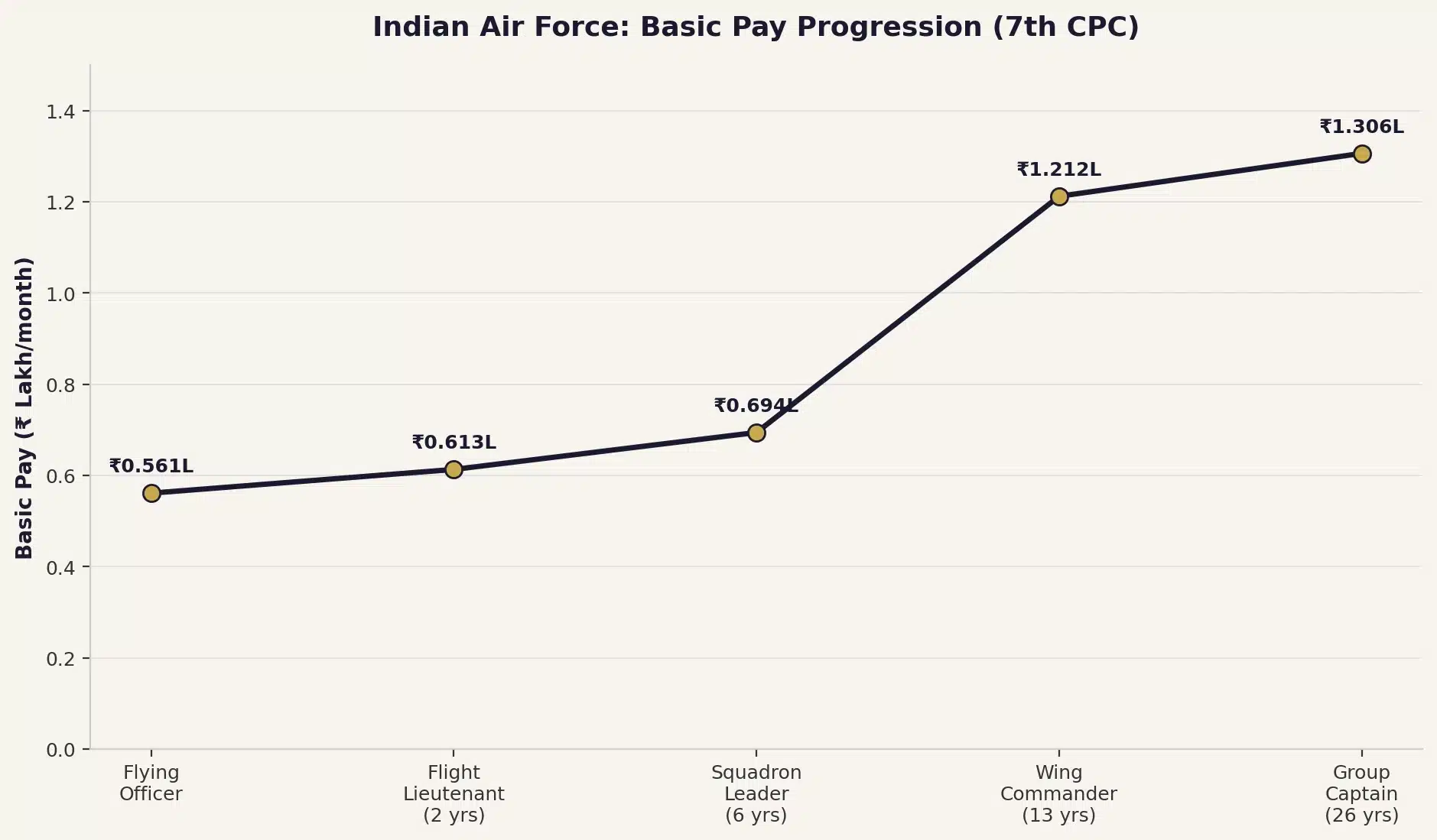
Both routes lead to identical pay and benefits once commissioned; the difference is only entry age and route. Under the 7th Pay Commission, basic pay progresses as follows:
Rank
Time to Reach
Basic Pay (per month)
Flying Officer
On commission
₹56,100
Flight Lieutenant
After 2 years
₹61,300
Squadron Leader
After 6 years
₹69,400
Wing Commander
After 13 years
₹1,21,200
Group Captain
After 26 years
₹1,30,600
On top of basic pay, an IAF pilot receives:
Flying allowance of ₹25,000–45,000/month (higher for fighter pilots than transport)
Dearness Allowance at roughly 50% of basic pay
Free accommodation, medical care, CSD canteen access, and subsidised education
Together these push net in-hand pay for a typical Flight Lieutenant to around ₹1.25–1.35 lakh/month, with total compensation value past ₹2 lakh/month once benefits are counted.
The trade-off: fighter and transport pilots log far fewer flying hours than an airline pilot, since sorties are mission-driven rather than scheduled block hours, so building airline-equivalent flying experience takes longer. But after roughly 10 years of service, many officers have a strong flying record and transition directly into commercial aviation, either after a 14-year Short Service Commission or later from a Permanent Commission, with training, accommodation, and a monthly stipend all covered by the Air Force throughout, unlike every other path in this section.
Helicopter Pilots
India’s helicopter operator base is small and concentrated around religious tourism (Char Dham/Kedarnath-style yatra routes) and offshore oil-and-gas support, led by Pawan Hans (government-owned, the largest single operator) and Global Vectra Helicorp. Pay runs lower than fixed-wing charter, typically in the ₹1.5–3.5 lakh/month range across First Officer to Captain, reflecting the smaller aircraft, seasonal demand (religious yatra routes run only part of the year), and limited number of operators.
The Flight Instructor Path
This is one of the highest-demand, most overlooked routes in Indian aviation right now, every CPL holder building hours toward an airline job needs an instructor to train under, and with 35 DGCA-approved Flying Training Organisations churning out cadets, that demand is structural rather than seasonal. As a rough industry rule of thumb, one active instructor is needed for every 10–15 students in the pipeline.
The route to becoming an instructor runs through a few clear steps:
Start with a CPL and a valid Instrument Rating (IR). The IR stays valid for 6 months from the date it’s issued, so a candidate must move on the instructor route within that window, or recency flying becomes an extra, avoidable cost.
Find a flying school willing to give a “patter” (pattern) flying slot. It’s worth explicitly asking each school whether they’re also offering a job afterward, since some only offer the training slot.
A Chief Flying Instructor (CFI) at that school trains the candidate through patter flying, for a total cost of roughly ₹7–8 lakh with a valid CPL/IR in hand.
If the CPL or IR has already lapsed beyond 6 months, recency flying must happen first to reactivate it before patter training can begin, pushing the total cost closer to ₹15 lakh.
After patter training comes a DGCA written exam and viva. Clearing both adds an Assistant Flight Instructor Rating (AFIR) onto the CPL; the same school’s CFI then does a final check flight before the candidate starts working as an AFI.
Career Ladder
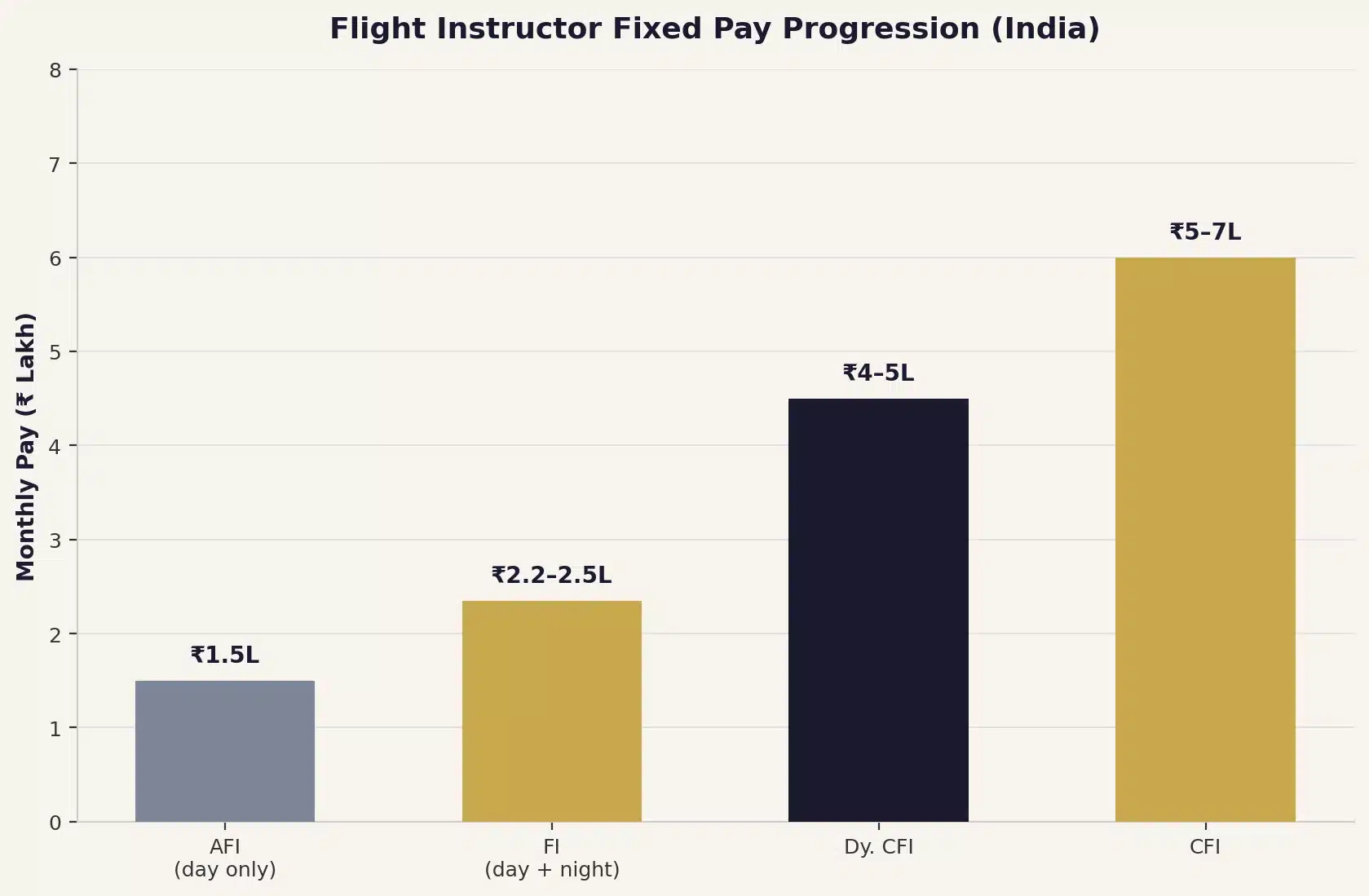
AFI (Assistant Flight Instructor): day-flying only, no night training. Pay is a fixed ₹1.5 lakh/month plus an hourly flying rate of roughly ₹500–700/hour on top.
FI (Flight Instructor): reached after roughly 500 hours as an AFI, via the same style of check/interview process. An FI can train night flying as well as day. Fixed pay moves to roughly ₹2.2–2.5 lakh/month, depending on the flying school.
Dy. CFI / CFI (Deputy / Chief Flying Instructor): reached after roughly 1,000–1,500 hours as an FI. This is the ceiling of the instructor career track within a flying school, both ranks are authorised to conduct IR checks, night-flying checks, and multi-engine checks, which AFIs and FIs cannot do.
These figures and mechanics come from founder/direct industry experience with Indian DGCA-approved flying schools rather than a single published fee schedule, costs and pay vary somewhat by school, but the overall structure (patter cost, AFI→FI→Dy.CFI/CFI progression, day/night training restrictions) is consistent across schools.
Beyond the flying-school ladder, experienced instructors have two further options:
Move into a Type Rating Instructor (TRI) role with an airline after gaining airline experience
Take DGCA-certified instructor jobs abroad in the UAE, Vietnam, or the Maldives, often with higher pay plus housing and travel benefits included
One clarification worth making: the very highest instructor-linked earnings, the ₹10 to ₹20 lakh a month range, come not from any Indian flying-school or airline instructor role but from flying as a Captain for a Middle East carrier such as those based in Saudi Arabia. That is a separate route, covered in the international section, not part of the domestic instructor ladder.
Emirates and International Pilot Salary
Once a cadet is released as a Junior First Officer, Indian airlines typically hold them to a bond of around 5 years with that carrier — a standard industry practice tied to the cost of training and type rating the airline has invested in the pilot. It’s worth setting expectations on this early: the first five years post-release are about building hours and experience with one employer, not about maximizing pay by hopping between airlines.
By the time that bond period is served out, a pilot typically has close to 2,500 flying hours and holds an ATPL, exactly the combination that opens the door to international carriers. The opportunities:
Emirates, Qatar Airways, Etihad, and Saudi Arabian carriers actively hire experienced Indian pilots
A smaller number of carriers in Vietnam and Indonesia also recruit Indian pilots
First Officers and Captains at these carriers can earn up to roughly three times what a comparable role pays in India
Salaries at these Gulf and Southeast Asian carriers are tax-free, so the entire figure lands in the pilot’s pocket, unlike the roughly 30% deducted on an Indian salary
Career Milestone
For a pilot who wants a real step-change in earnings rather than incremental in-India growth, international carriers are where it happens. The peak figure of ₹20 lakh a month is realistic at the senior end.
For Indian pilots, Emirates pilot salary is the benchmark most people look at. An experienced First Officer or Captain at Emirates, Qatar Airways or Etihad can earn up to roughly three times comparable Indian pay, tax-free, which is how senior pilots reach the ₹20 lakh a month mark. Emirates lists its current pilot openings and entry requirements on its official pilot careers page. Gulf carriers also run cadet programs that take Indian students straight into airline training.
International hiring is cyclical and depends on each carrier’s fleet expansion and visa/licence conversion requirements at the time — this is a realistic pathway, not a guaranteed one. A detailed, airline-by-airline breakdown of Middle East and international pay scales will be covered in a separate linked article rather than here.
Beyond Captain: Instructor, Management, and Regulator Tracks
Becoming Captain isn’t the ceiling on a domestic career either. Roughly two years after upgrading to Captain or Commander, a pilot becomes eligible to move onto one of three tracks that sit alongside, not instead of, regular flying: the instructor ladder, a management pilot role, or a move to the regulator itself.
The instructor ladder runs in three defined grades, each a step up in responsibility and pay:
LTC, Line Training Captain: trains newly released pilots directly on the line, flying real revenue sectors alongside the trainee in the actual aircraft.
TRI, Type Rating Instructor: trains pilots converting onto a new aircraft type, working with them in both the simulator and the aircraft during type rating.
DE, Designated Examiner: the highest instructor grade, dual-authorised by both the airline and the DGCA. A DE conducts every pilot’s annual Instrument Rating and Proficiency Check (IR/PPC), effectively the final sign-off on whether a pilot stays current to fly. It’s the highest position a pilot can hold within the flying side of the profession.
Each of these grades carries its own fixed allowance on top of regular Captain pay, covered earlier in this document under Trainer Allowances (LTC, TRI, DE).
Separately, some Captains move away from an instructor path and into a management pilot role instead, taking on an airline function like Safety, Training, or Fleet management as their primary responsibility, with flying duties continuing alongside rather than being the main job.
A smaller number of experienced Captains move outside the airline system entirely, joining the DGCA as a Flight Operations Inspector (FOI). In this role, the pilot works directly with the regulator, helping shape rules and regulations and conducting audits of airlines’ flight operations. It pays roughly ₹7 lakh a month, and unlike every other track in this document, it makes the pilot a government employee.
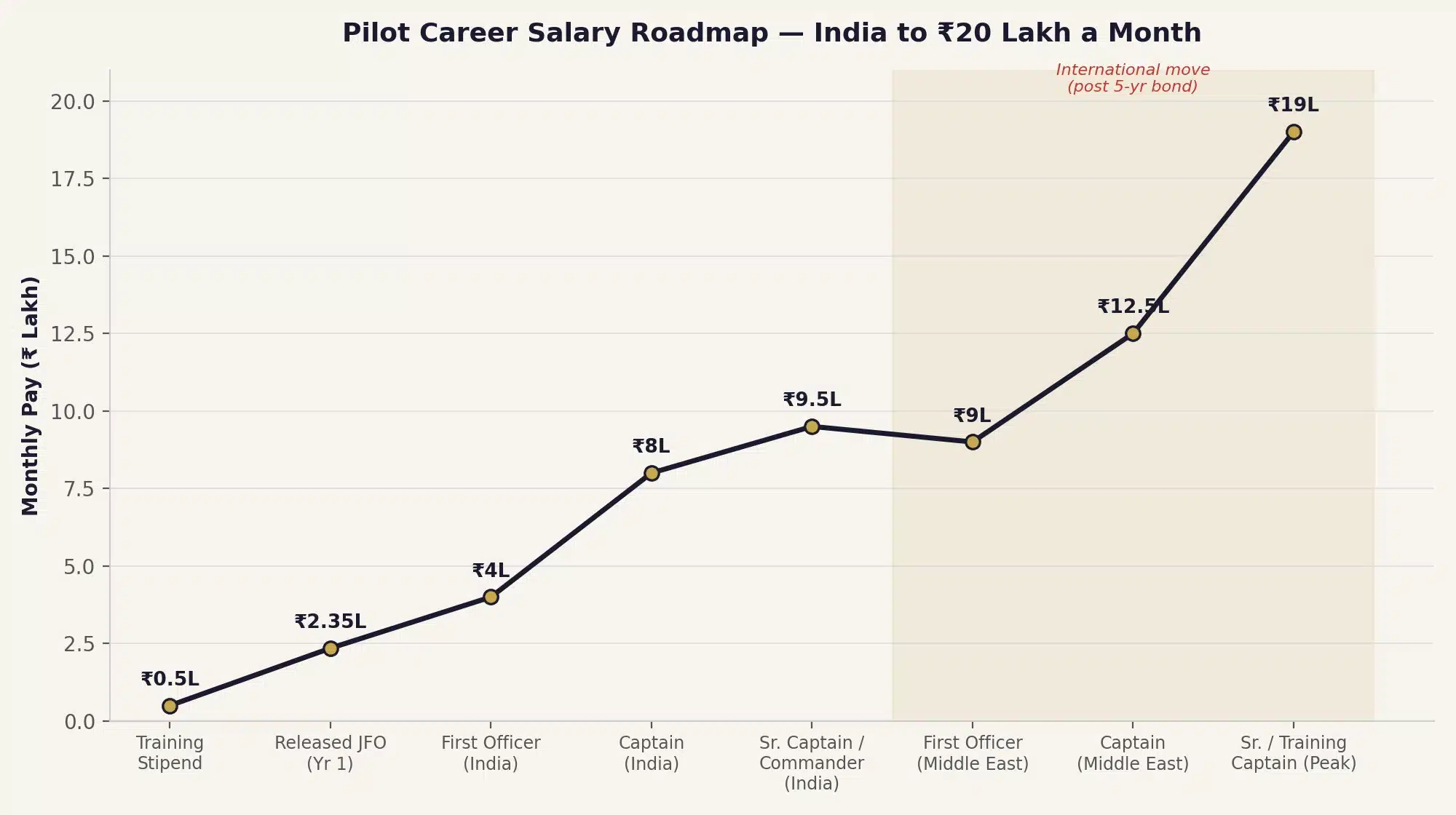
A Pilot’s Roadmap to ₹20 Lakh a Month
Put the domestic and international stages together, and the realistic long-run trajectory for an Indian commercial pilot looks like this:
Stage
Timeline
Approx. Monthly Pay
Training stipend
Year 1
₹50,000
Released First Officer
First 1–2 years
₹2.5–3.5 lakh
Captain (in India)
Roughly 8–10 years in
₹7.5–10 lakh
International Captain (post-bond)
After moving abroad
Up to ~3x India pay, tax-free
Senior / Training Captain (peak)
Senior end of career
₹20 lakh realistic
The peak figure of ₹20 lakh a month is realistic at the senior end, typically for a Senior Captain or Training Captain with significant hours, either at a top-paying international carrier or in a senior training role at an Indian airline, once seniority pay increases, trainer/instructor allowances (LTC/TRI/DE), and IndiGo-style longevity payouts are all counted.
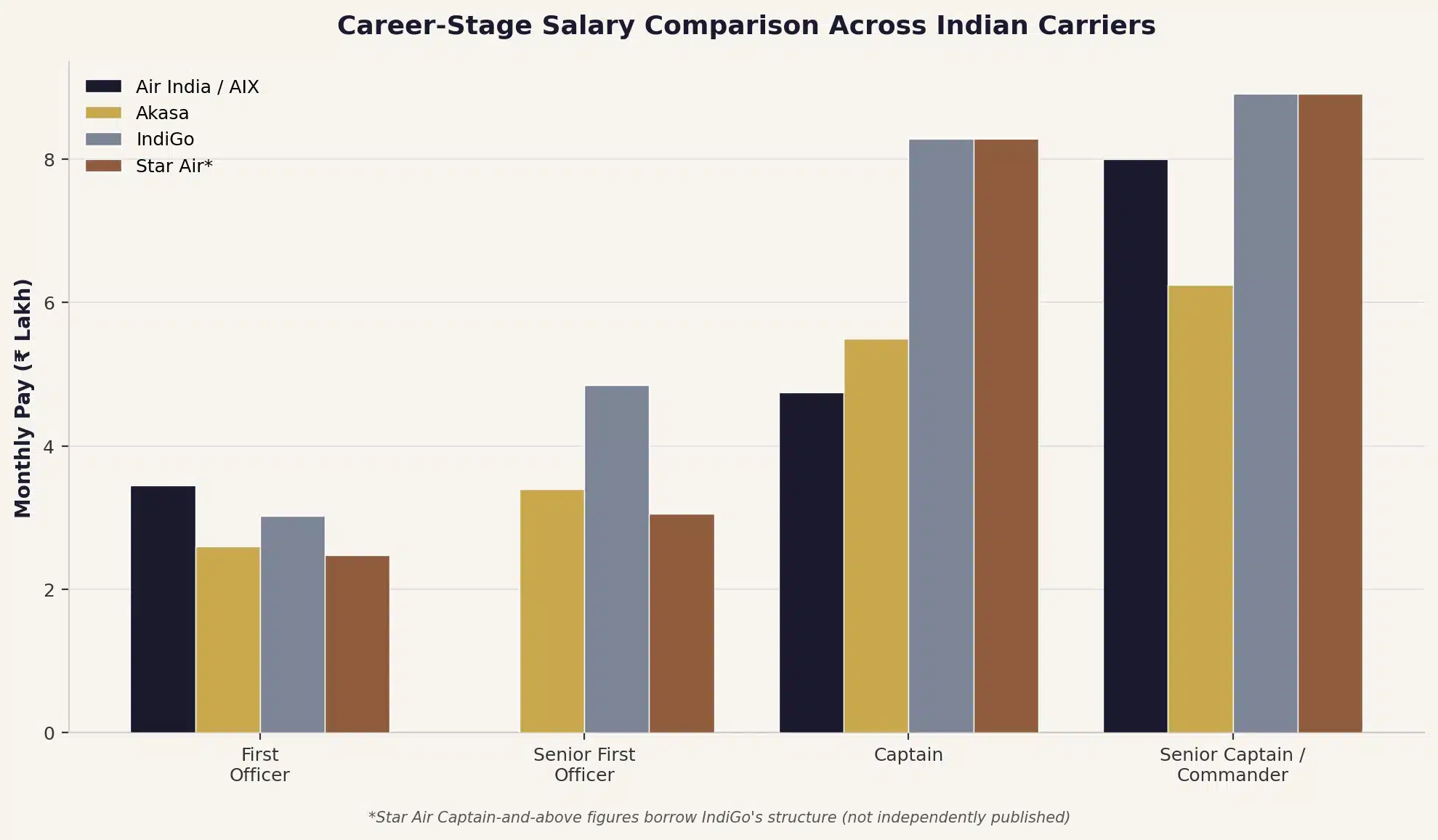
Commercial Pilot Salary in India: Airline Comparison at a Glance
Pulling every airline covered in this document into one table, aligned by rough seniority level rather than exact job title:
AIX/Akasa figures are base fixed pay only (40 hrs), hourly flying allowance adds to this. IndiGo’s figures are all-in CTC already benchmarked at 70 hrs. Star Air’s First Officer/Sr. FO figures shown are @70-hrs CTC from its own published Annexure (a second @80-hrs scale also exists, see the Star Air section above). *Star Air Captain-and-above figures are not published by the airline, these cells borrow IndiGo’s Captain/Sr. Captain/LTC/TRI structure as a placeholder estimate and should be replaced with confirmed Star Air numbers as soon as they’re available. Rank titles are aligned by rough seniority, not exact equivalence.
Career Roadmap, Visualised
The same trajectory covered earlier, training stipend through to a senior international role, plotted against monthly pay:
Values are indicative midpoints of the ranges discussed earlier in this document, not guaranteed figures for any individual pilot or airline.
Every Pilot Profession, Side by Side
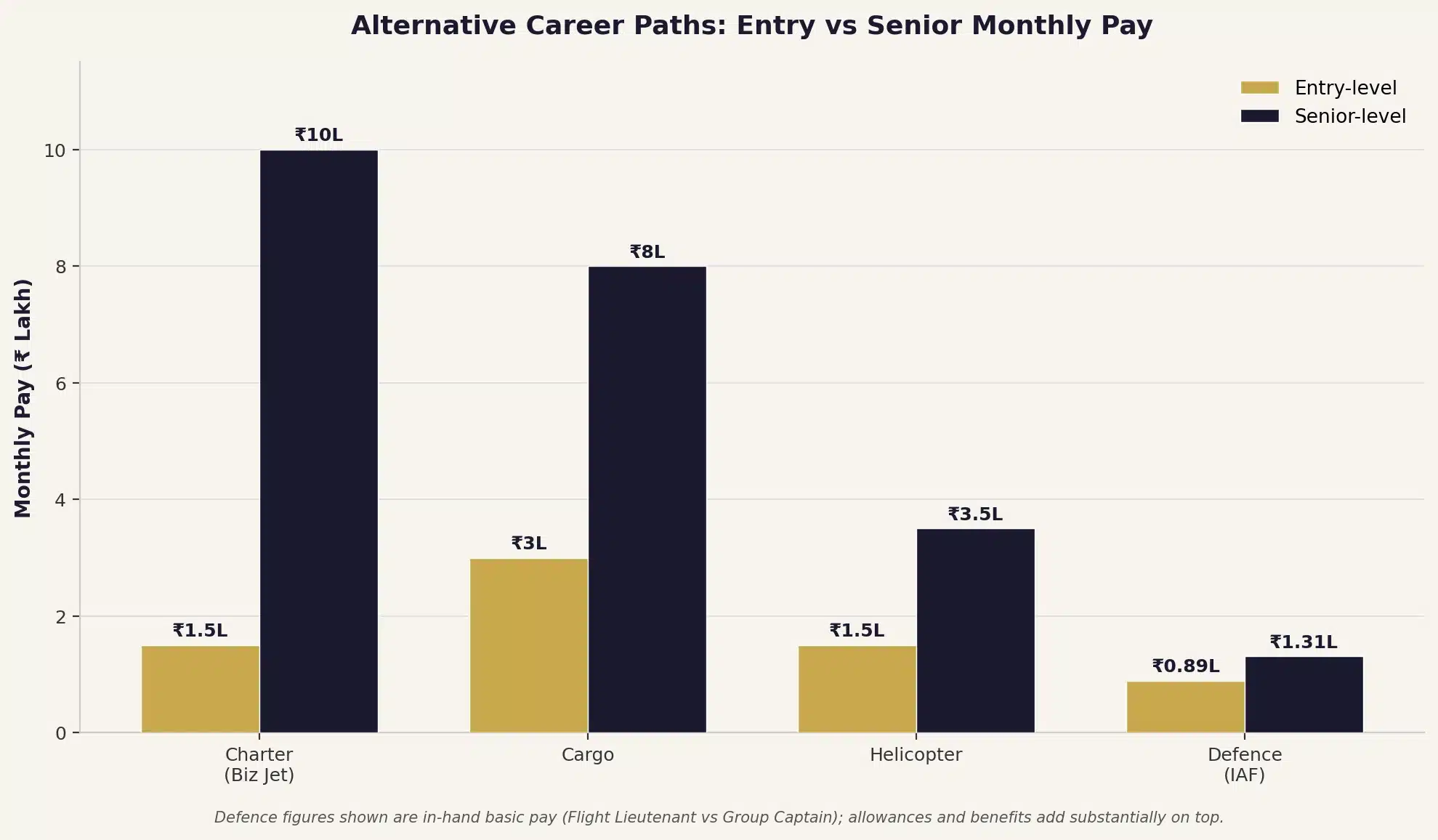
Bringing every career path in this document into one place, here is roughly what an entry-level and a senior pilot earn per month across the airlines, the charter and cargo world, defence, helicopter flying, and instructing. Figures are monthly and, unless noted, pre-tax.
Profession
Entry-Level (per month)
Senior-Level (per month)
Notes
Scheduled Airline (Air India / AIX)
₹2.35 lakh (released FO)
₹8.5 lakh (Sr. Commander)
40-hr fixed pay + flying allowance
Scheduled Airline (IndiGo)
₹2.67 lakh (FO)
₹8.91 lakh (Sr. Captain)
70-hr committed CTC
Scheduled Airline (Akasa)
₹2.6 lakh (FO)
₹6.25 lakh (Sr. Transition Capt.)
40-hr fixed pay + flying allowance
Middle East Airline (e.g. Saudi, Emirates)
₹8 lakh (First Officer)
₹15–20 lakh (Captain)
Tax-free; after bond + 2,000 hrs
Charter (Business Jet)
₹1.5 lakh (FO)
₹10 lakh (Captain)
Very few operators, few openings
Cargo (Blue Dart / QuikJet)
₹3 lakh (FO)
₹7–8 lakh (Captain)
Small fleets; hires from airlines
Helicopter (Pawan Hans etc.)
₹1.5 lakh (FO)
₹3.5 lakh (Captain)
Seasonal; limited operators
Defence (Indian Air Force)
₹1.25 lakh (Flt Lt, in-hand)
₹2 lakh+ (Group Capt., total value)
Free training; free housing, pension
Flight Instructor (flying school)
₹1.5 lakh (AFI)
₹5–7 lakh (CFI)
High demand; AFI→FI→CFI ladder
Airline and Middle East figures assume the flying-hour and experience conditions described earlier in this document. Charter, cargo, helicopter and instructor pay varies widely by operator and utilisation. Defence pay is government-scale and comes with benefits (housing, medical, pension, subsidised education) that add substantial value beyond the cash figure. All numbers are indicative, not guaranteed offers.
Why Pilot Demand in India Is About to Outpace Every Other Career Bet
Ask most parents what a stable career looks like in 2026 and aviation still isn’t the first answer that comes to mind. That’s a mistake worth correcting with numbers rather than opinion. The market picture:
India is now the world’s third-largest aviation market by passenger traffic, moving close to 174 million passengers a year
Yet that’s only around 4% of global air traffic, against a population making up nearly 18% of the world’s people
The United States carries a far larger share of global traffic with barely a quarter of India’s population, so the gap looks less like a limitation and more like runway
The order books back this up:
IndiGo alone has ordered more than 1,300 Airbus aircraft, the largest single aircraft purchase in commercial aviation history
Air India has its own multi-hundred aircraft pipeline underway
Well over a thousand aircraft are due for delivery across the two carriers through the 2030s
Every aircraft needs a full crew of pilots across multiple shift patterns, not just one; industry estimates put India’s incremental pilot requirement at 30,000 to 34,000 over the next 10 to 15 years
Government policy has leaned into this rather than sat on the sidelines:
The UDAN regional connectivity scheme has pushed operational airports from 74 in 2014 to over 160 today
The target is 350–400 airports by the time India marks 100 years of independence in 2047
More airports and routes mean more aircraft rotations, which circles back to the same constraint: a shortage of trained pilots, not a shortage of demand for them
This is macro context for why the profession is worth pursuing seriously. It isn’t investment advice, and individual airline hiring still moves in cycles.
Two Ways Into the Cockpit: Cadet Programs vs the Conventional Route
Once someone decides to train as a commercial pilot, there are really only two doors into an airline, and they lead to very different timelines and costs.
1. The Cadet Pilot Program (Airline-Selected, Self-Funded Route)
This is the structured, airline-backed pathway, but it’s worth being precise about who actually pays for it, since “cadet program” gets used loosely. It begins with a selection process rather than a training enrolment. The stages are:
Aptitude assessments such as ADAPT, COMPASS, or Symbiotics-style tests
Psychometric evaluation with a panel psychologist
English Language Proficiency (ELP) test
Group discussions on current and technical topics
A personal interview covering situational judgement, technical knowledge, and HR fit
Clear all of that and the airline issues a Letter of Intent, effectively a conditional job offer before flight training has even begun. From there, the airline (or its training partner) takes the cadet through ground theory, flight training, and type rating, with a job guaranteed at the end subject to satisfactory performance. The partner FTOs include:
IndiGo: CAE Oxford / Chimes, FTA Adelaide (Australia), NZ International Airline Academy, Alpha Aviation / South Africa partners, Skyborne (USA), Marigold Aviation (Thailand)
Air India: AeroGuard (Phoenix/Chandler, Arizona) and L3Harris (Sanford, Florida)
The part that surprises many families: this route is self-funded, not airline-sponsored. Key facts to know:
IndiGo’s Cadet Pilot Program runs approximately ₹95 lakh to ₹1.2 crore all-in (ground school, CPL, multi-engine and instrument rating, and A320 type rating bundled together)
Air India’s runs similarly, around ₹1 crore to ₹1.2 crore
No stipend is paid during this training period; the cadet or their family funds it, typically through an aviation education loan
The full cycle from selection to airline induction typically runs 18 to 24 months
Key Insight
What the airline is really selling here is certainty — a guaranteed seat and a fixed timeline, not a subsidy.
2. The Conventional Route (Self-Funded Training, No Guaranteed Seat)
Here the aspiring pilot funds and completes ground theory and flight training independently, in India or abroad (South Africa, USA, Europe, New Zealand, Australia are the common circuits), clears the DGCA’s theory and flying tests, and, if trained overseas, converts the foreign licence to a valid Indian CPL. After that comes the harder part:
Airlines typically open only 400 to 500 conventional vacancies a year
A candidate may also need to self-fund a type rating (A320 or B737) before or after securing a CPL, depending on the airline’s hiring requirement at the time
There is no guaranteed placement; a pilot can finish a CPL and type rating and still wait months or years for a vacancy
The real difference between the two routes isn’t who flies first, it’s who carries the financial risk. The cadet program bundles a higher total cost with a guaranteed outcome; the conventional route can come in cheaper stage-by-stage but carries real placement uncertainty at the end.
What Conventional CPL Training Actually Costs
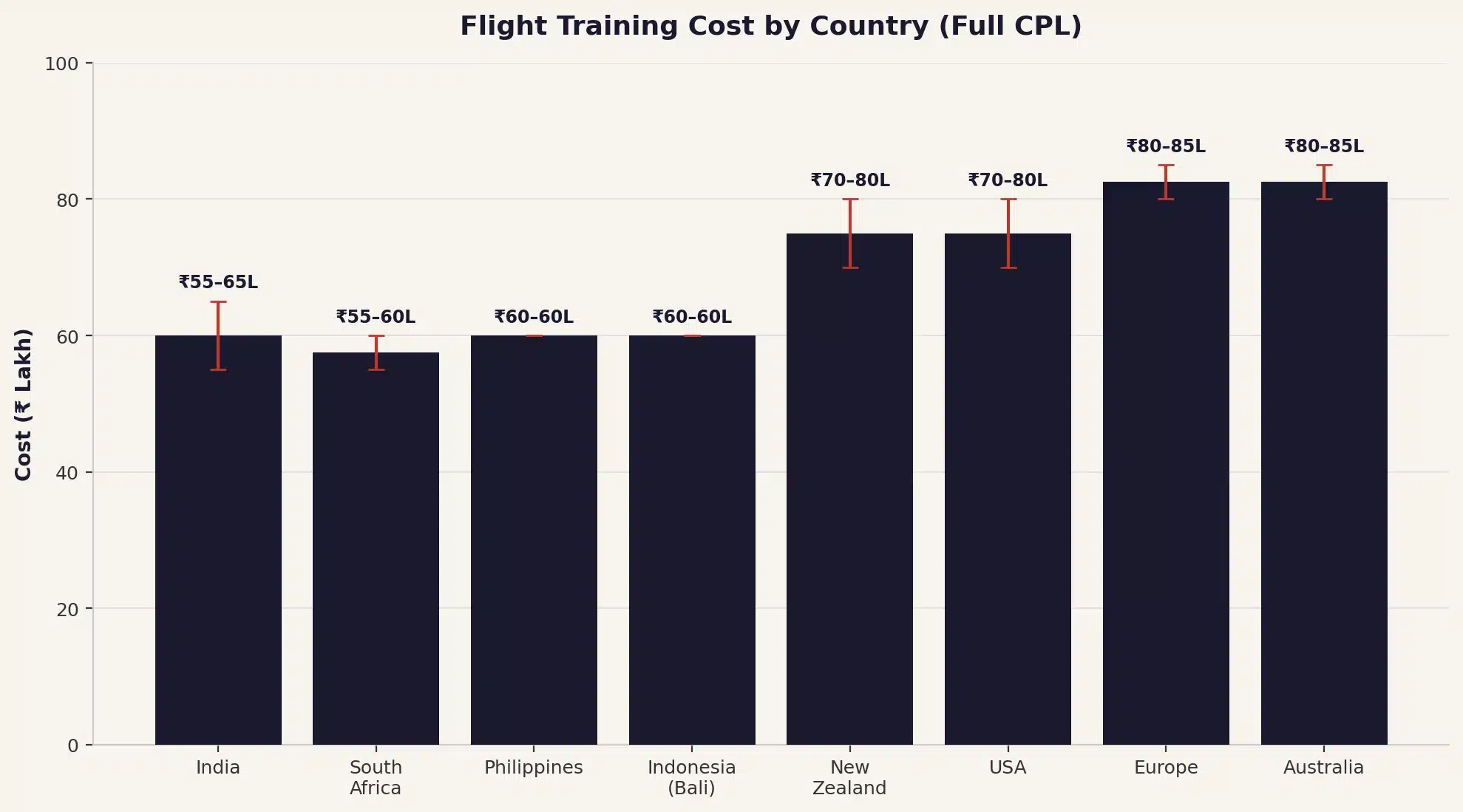
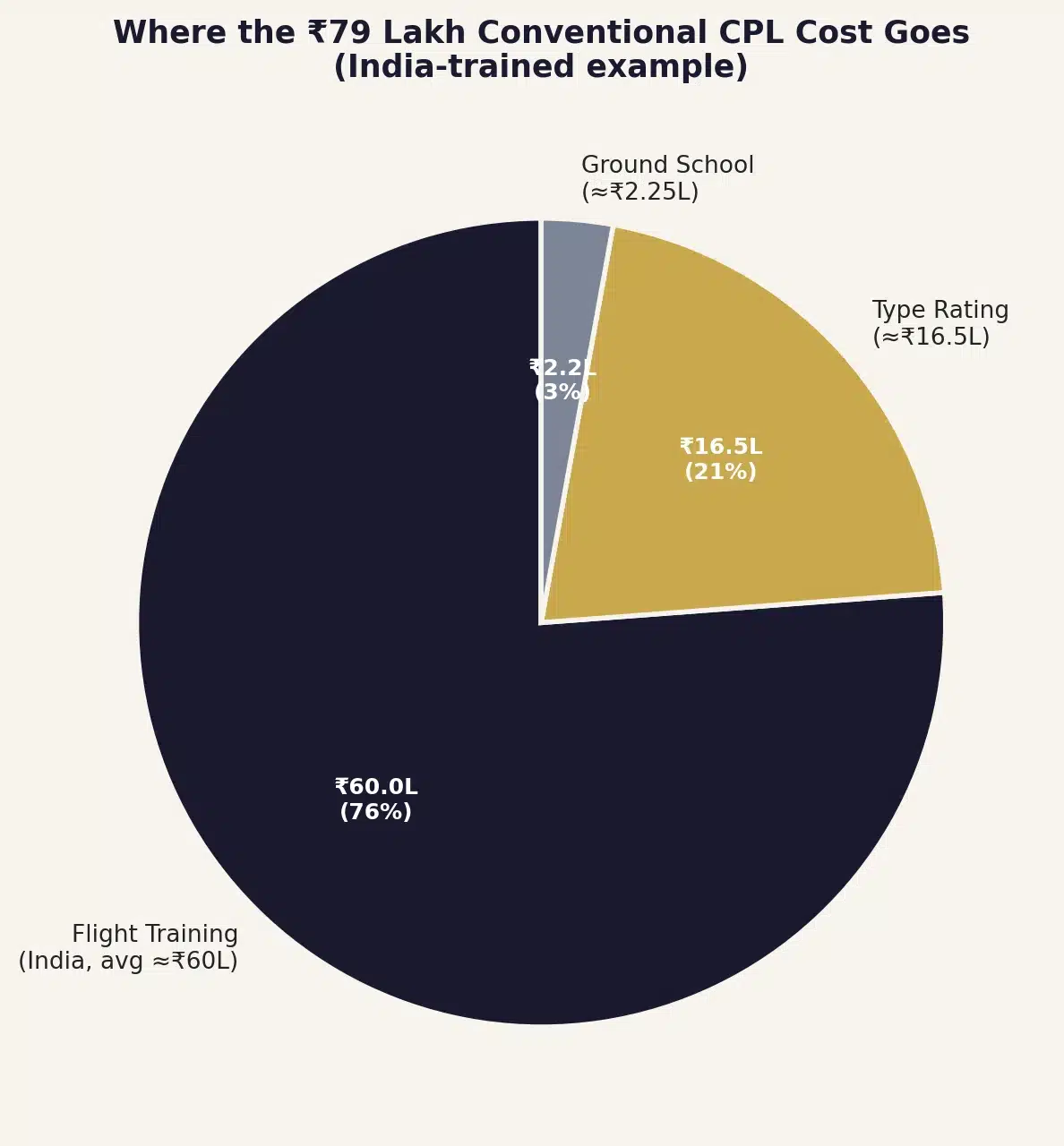
For anyone going the conventional route rather than an airline cadet program, the total bill is built in stages — ground school, flight training (which varies a lot by country), a separate type rating, and in some cases an airline-specific training fee on top. Here’s what each stage realistically costs in 2026.
Stage
Approx. Cost
DGCA ground classes (CPL theory)
₹2–2.5 lakh
Flight training, India
₹55–65 lakh
Flight training, South Africa
₹55–60 lakh
Flight training, Philippines
≈₹60 lakh
Flight training, Indonesia (Bali)
≈₹60 lakh
Flight training, New Zealand
₹70–80 lakh
Flight training, USA
₹70–80 lakh
Flight training, Europe
₹80–85 lakh
Flight training, Australia
₹80–85 lakh
Type rating (A320 or B737 family)
₹15–18 lakh
Flight training costs vary by FTO within each country, and figures here are founder/industry estimates rather than a single published price list — always confirm current fees directly with the specific school. Independent industry trackers place Indian FTO packages as high as ₹86 lakh and overseas packages above ₹1 crore when CPL and type rating are bundled together, so treat the ranges above as a realistic floor rather than a ceiling.
Airline Training Fees: Air India Express vs IndiGo (Direct-Entry, Non-Cadet)
Once a conventional CPL holder has a type rating (or is applying without one), the airline itself may or may not charge an additional fee before letting them join as a direct-entry First Officer, and this is a real, current point of difference between carriers.
Air India / Air India Express: no additional airline training fee for type-rated direct-entry pilots. A non-type-rated CPL holder funds their own type rating externally (the ₹15–18 lakh above); AIX itself doesn’t charge a separate bridge or induction fee on top. This lines up with AIX’s own published stipend structure covered earlier in this document — ₹20,000/month until endorsement, ₹50,000/month post-endorsement until released for unsupervised flying.
IndiGo: charges a “bridge course” fee of roughly ₹10 lakh for an already type-rated direct-entry pilot to convert onto IndiGo’s own SOPs and systems. For a non-type-rated CPL holder, IndiGo bundles the type rating and bridge course together for approximately ₹30 lakh total. Stipend during this induction period starts around ₹70,000/month and rises toward ₹1 lakh/month as training progresses.
Important Note
This bridge-course/direct-entry route is a separate, cheaper track from IndiGo’s ab-initio Cadet Pilot Program covered above (₹95L–1.2Cr, zero flying experience to JFO). The two get conflated easily since both lead to a JFO role at IndiGo, but they start from a different point (zero hours vs. already CPL/type-rated) and cost roughly 3–4x apart. These specific bridge-course figures are founder/industry estimates rather than an IndiGo-published fee schedule, and are worth confirming directly with IndiGo’s recruitment team before budgeting against them.
The Bottom Line
A pilot career in India today isn’t a bet on a single airline’s fortunes, it’s a bet on a market that’s short by tens of thousands of trained pilots against a fleet expansion that’s already been paid for and ordered. Whether that career starts through an airline cadet program or the conventional self-funded route, the pay structure that follows is now fairly transparent and broadly similar across Air India, Air India Express, Akasa, and IndiGo: a modest training stipend, a released-FO salary that roughly doubles within a couple of years, and a path to Captain-level pay that clears seven figures annually well before mid-career, with IndiGo’s committed-hours model pushing that ceiling even higher for pilots who stay long enough to cross the 1,000- and 2,500-hour experience bands.
The bigger variable isn’t the pay table, it’s how well-prepared a candidate is for the selection process that decides which of these pay tables they end up on.
Confused About Your Career Path?
Our airline pilot mentors have flown with Air India, IndiGo, SpiceJet and Vistara. Get unbiased, one-on-one guidance on which route and airline is right for you.
Cadet programs start from 17. Upper limits vary by airline, and the conventional route has its own separate limits:
Airline
Cadet Route
Conventional Route (fresher)
Air India / AIX
Up to 30 (40 if already an Air India employee)
Up to 30
IndiGo
Up to 40 on some partner programs (e.g. Marigold)
Up to 36
SpiceJet
—
36 and above
Akasa
—
No age limit
flydubai / Air Arabia
From 17
—
You need Physics, Maths and English, not Chemistry. There is no percentage requirement for the conventional route. Cadet programs do set one: IndiGo asks 51% in Physics, Maths and English, Air India 60% aggregate, and flydubai 70% aggregate.
No. You need a DGCA Class 2 medical to start and a Class 1 to fly commercially, and glasses are completely fine for both.
Yes. There is no gender bar at any stage. Anyone who clears the medical and completes ground and flight training can fly.
Around 200 hours.
65, subject to clearing your medical every year.
Choosing a Route
Neither. Both routes end at the same airline job on the same pay scale. What differs is the cost and certainty of getting there, not the salary once you’re in.
In the cadet route you get a Letter of Intent up front, and the airline routes your ground training, flight training and type rating through its partner FTOs, with a job at the end. In the conventional route you arrange and fund every stage yourself, then wait for a vacancy and compete for it.
The cadet route, because the seat is guaranteed and the cycle runs a fixed 18 to 24 months. The conventional route can add months or years waiting for a vacancy to open.
The instructor route is the usual fallback and is in genuine demand: around ₹1.5 lakh a month as an AFI, rising to ₹5–7 lakh as a CFI. Charter and cargo are options too, though both are small markets.
Cost, Fees & Loans
Roughly ₹95 lakh to ₹1.2 crore through a cadet program, or about ₹75 to ₹80 lakh through the conventional route if you train in India. Training abroad costs more.
No. There is no stipend while you’re doing ground school, flight training or type rating. Pay only starts once you formally join the airline.
Normally no. Budget 5–10% extra as a buffer for any additional flying hours or fuel price increases during training.
On performance grounds you normally get three chances first. If you still can’t continue, the portion of training you’ve already used is deducted and the balance is refunded. If you leave for any other reason, it depends on that airline’s or FTO’s policy, though the same principle usually applies.
Yes, and it’s a proper education loan. The airline points you to its partner banks, which lend against your Letter of Intent plus collateral. Repayment starts only after your training finishes.
You’ll get a loan, but usually not an education loan. You’ll need collateral, repayment typically starts immediately (sometimes at a reduced amount during training), and interest runs around 8–9%.
On First Officer pay of ₹2.35 to ₹3.45 lakh a month, a full education loan is typically cleared in about 5 to 7 years, well before mid-career.
Salary & Pay
It depends on the stage. Trainees get a stipend of about ₹50,000 a month, First Officers earn ₹2.35–3.45 lakh, Captains earn ₹7.5–10 lakh, and senior or international captains can reach ₹15–20 lakh a month.
About ₹2.35–2.67 lakh a month once you are released as a First Officer at Air India Express or IndiGo. During airline training before release, you get a stipend of about ₹50,000 to ₹1 lakh a month.
Across the major airlines, a First Officer earns roughly ₹2.5–3.5 lakh a month and a Captain ₹7.5–9 lakh a month. Pay rises with rank, flying hours and the airline you fly for.
IndiGo pays a monthly CTC committed at 70 flying hours: ₹2.67 lakh for a First Officer under 1,000 hours, ₹3.37 lakh above 1,000 hours, ₹4.85 lakh for a Senior First Officer, ₹8.15–8.42 lakh for a Captain and ₹8.91 lakh for a Senior Captain.
Under the Air India Express structure (Air India runs a comparable one), pay at 70 flying hours a month is ₹2.35 lakh in the first year after release, ₹3.45 lakh as a First Officer, ₹4.75 lakh as an SFO holding an ATPL, ₹7.5 lakh as a Commander and ₹8.5 lakh as a Senior Commander.
A Flying Officer starts on basic pay of ₹56,100 a month under the 7th Pay Commission, plus a flying allowance of ₹25,000–45,000 and Dearness Allowance of about 50% of basic pay. Basic pay rises to ₹1,21,200 for a Wing Commander.
Yes. An IndiGo Captain with more than 1,000 hours earns a CTC of about ₹8.42 lakh a month, which is just over ₹1 crore a year. Senior Captains and training captains earn more.
Roughly 18 to 24 months of training, after which a stipend starts from the day they join the airline.
A stipend of roughly ₹50,000 to ₹1 lakh a month, depending on the airline and your training phase. IndiGo, for instance, moves you up the band as training progresses.
Around ₹2,35,000 a month as a Junior First Officer for the first year, rising to about ₹3,45,000 once you cross one year and become a First Officer.
Once you have 1,500 hours and an ATPL. Pay moves to roughly ₹4,75,000 a month.
Yes. Every hour flown beyond your fixed-pay band is paid at your rank’s hourly flying rate, which steps up as you fly more.
Yes. Positioning as a passenger to operate a flight from another base is paid at 65% of your applicable flying allowance rate.
International layovers pay roughly $150–200 per night. Domestic layovers pay around ₹1,500 to ₹3,000 per night, depending on rank and airline.
Yes, roughly ₹55,000 to ₹1 lakh a month on top of your flying pay.
Through instructor grades, each adding a fixed monthly allowance: LTC adds about ₹50,000, TRI about ₹1 lakh, and DE (Designated Examiner) about ₹1,50,000.
Roughly 30% at these income levels. Every figure in this guide is gross, pre-tax.
Benefits & Insurance
Temporary unfitness: the airline keeps paying your base salary, typically for around 3 to 6 months. Permanent unfitness: insurance pays out roughly ₹2 crore, with a top-up option to about ₹4 crore.
Yes. You and your immediate family are covered under the airline’s policy, and you can buy a top-up for wider cover.
Yes. You, your spouse and your immediate family get complimentary tickets across the airline’s network and its codeshare partners, subject to seat availability.
Flying Abroad
Build 1,500+ hours with an ATPL at an Indian airline, then apply directly. Starting First Officer pay runs up to about ₹8 lakh a month, tax-free.
Emirates, Etihad, Qatar Airways, flydubai, Air Arabia, the Saudi carriers, and some Vietnamese and Indonesian operators. Most pay up to three times Indian pay, tax-free.
CA
Captain Akhil
6,000+ hours of flying experience • Commander at Jet Airways, SpiceJet & Vistara
Captain Akhil has spent his career in the cockpit and in command, flying as a Commander with Jet Airways, SpiceJet and Vistara. That first-hand experience across three major Indian carriers informs every figure and pathway in this guide, from cadet and conventional entry routes to pay structures and long-term career progression. The numbers here combine that direct cockpit and command knowledge with current published airline data.